





Centrifugal fans are not automatically quieter than other fan types, but they can be engineered to operate quietly, especially when sized correctly and run at moderate speeds. Whether a centrifugal fan is quieter than an axial fan in a given project depends on airflow, pressure, speed, blade design and how the fan is installed and silenced.
Noise from any fan is closely linked to blade tip speed and turbulence. As tip speed increases, aerodynamic noise usually rises. Many centrifugal fans are used for higher-pressure duties, which can mean higher internal velocities and more noise. However, if engineers select a larger centrifugal fan and operate it at a lower rotational speed to achieve the same duty, tip speed can be reduced and noise lowered, often more effectively than trying to quiet a small high-speed fan.
The impeller and housing design also matter. Backward-curved and airfoil centrifugal fans operating near their best efficiency point generally produce less aerodynamic noise than designs suffering from stall or heavy flow separation. Poor inlet or outlet conditions, such as elbows close to the fan or sudden area changes, create extra turbulence, which adds noise regardless of fan type.
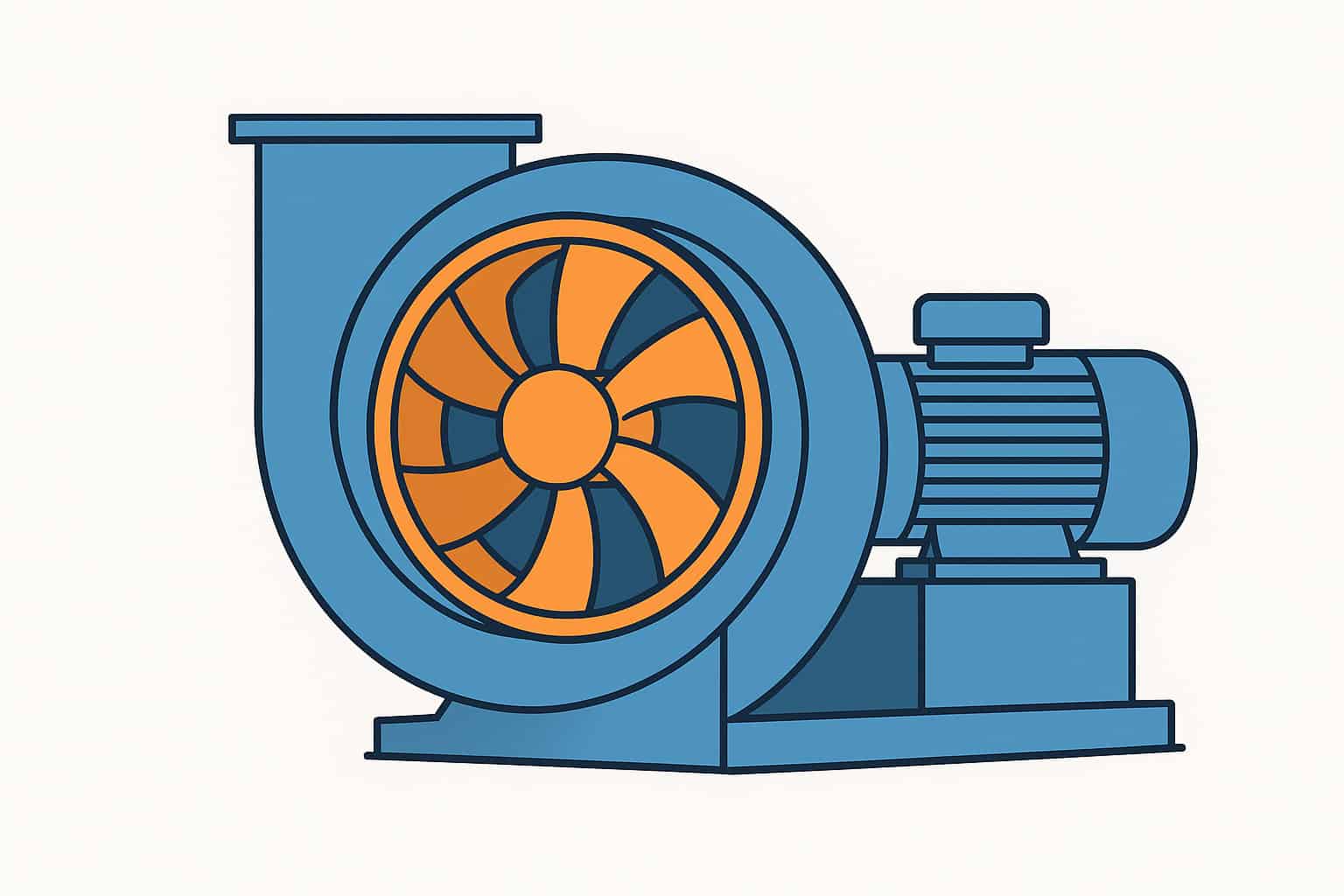
Compared with an open axial fan, a centrifugal fan has an enclosed scroll housing, which can help contain some of the sound. On the other hand, the scroll and higher internal velocities can generate their own noise. Without silencers or acoustic treatment, both axial and centrifugal fans used for high flow and pressure can be loud.
In industrial and mining ventilation, noise control is often achieved through a combination of fan selection and acoustic accessories. This can include choosing a fan with good aerodynamic design, running it at lower speed, adding inlet and outlet silencers, using flexible connectors to reduce structure-borne noise and enclosing the fan in an acoustically treated room or housing. With this approach, large centrifugal fans used as main mine fans or process exhaust blowers can meet strict noise limits at nearby workplaces or property boundaries.
Mechanical noise from the motor, bearings and drives also contributes to overall loudness. Proper alignment, balancing, lubrication and maintenance reduce mechanical noise and vibration. These issues are common to both axial and centrifugal fans; neglecting them will make any fan noisy.
In summary, centrifugal fans are not inherently quieter than axial fans or other types. Noise depends on speed, design, system layout and acoustic treatment. However, large, well-designed centrifugal fans operating at moderate speeds with suitable silencers can provide powerful industrial and mining ventilation while keeping noise at acceptable levels.