
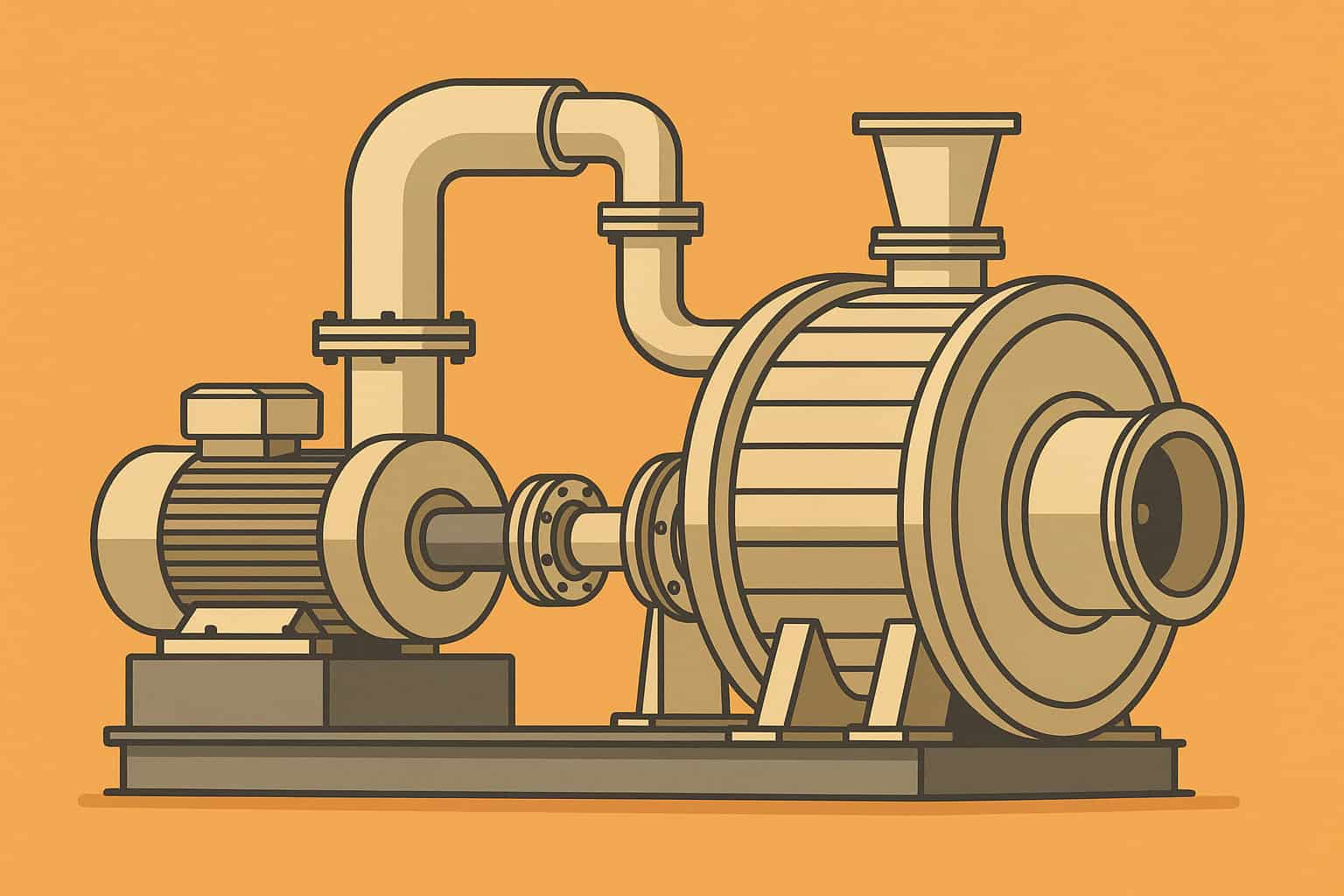
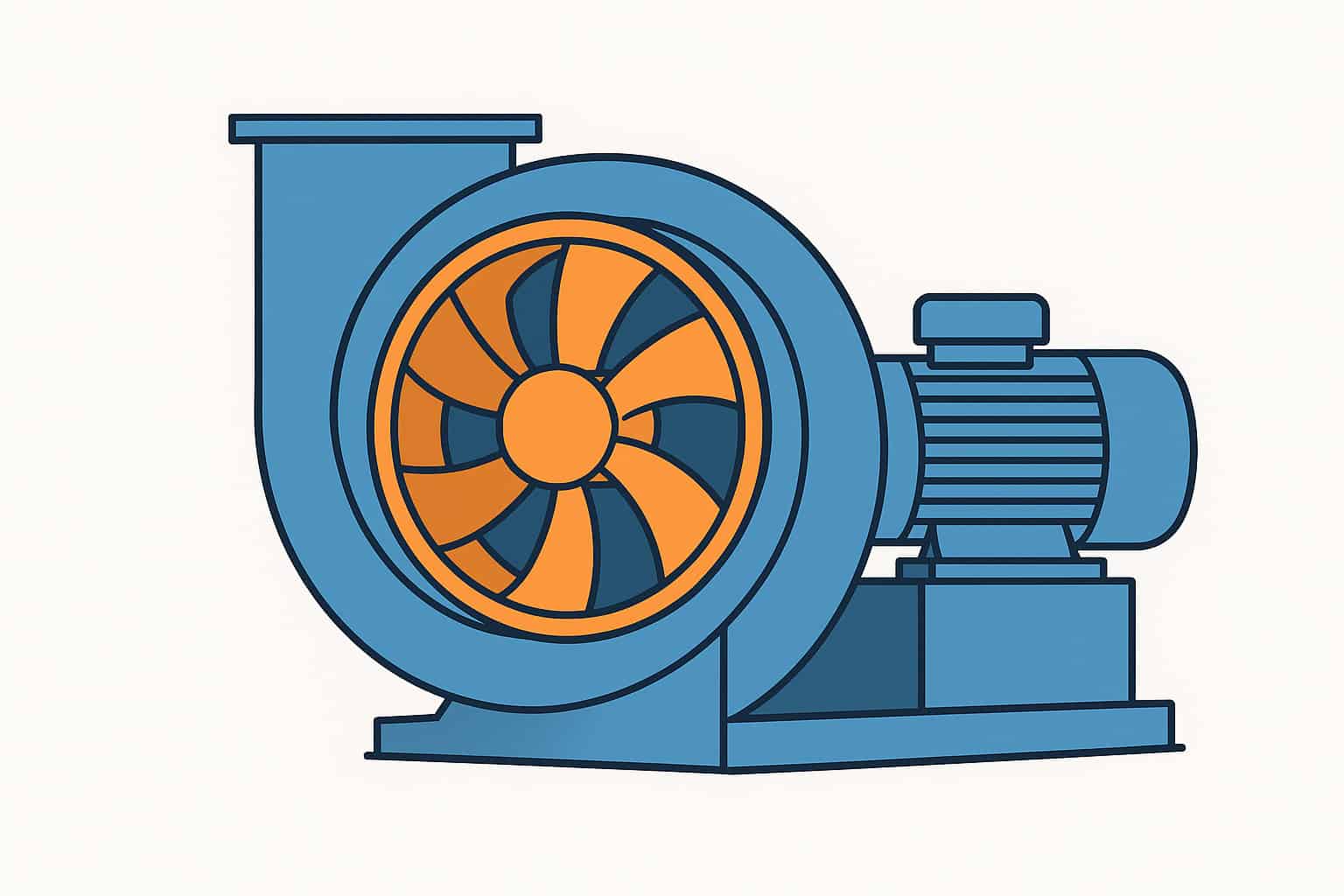
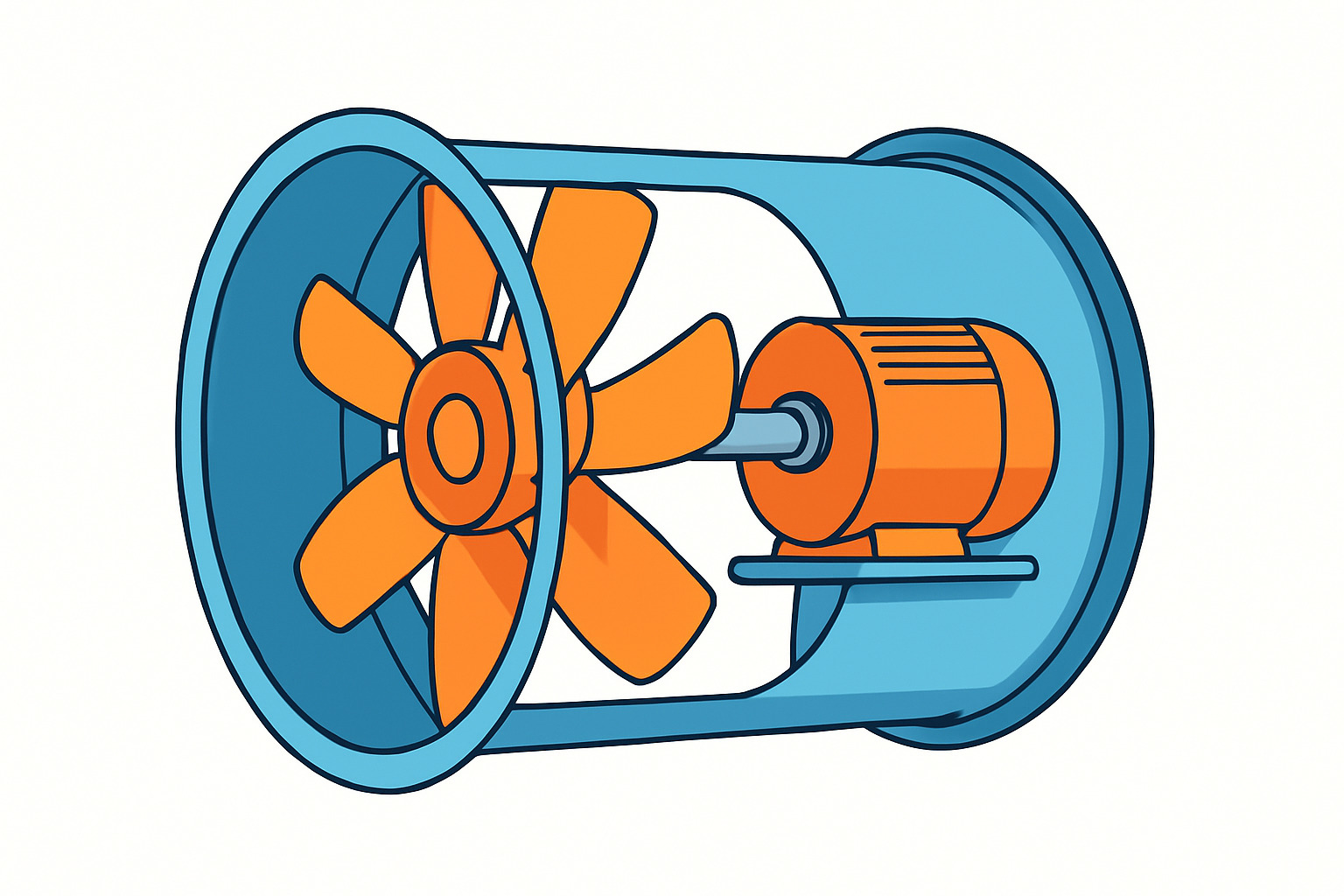
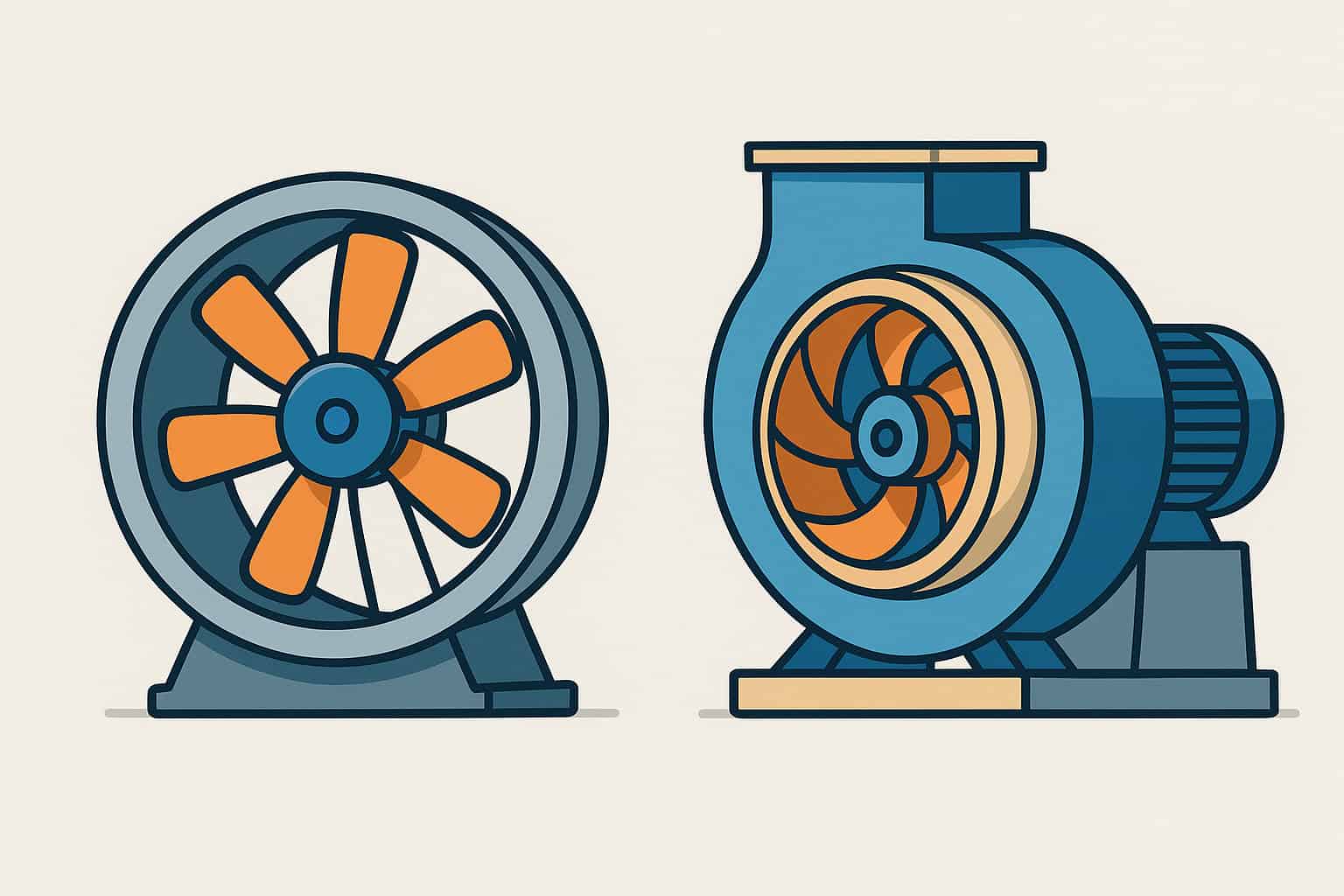
A centrifugal fan (often called a radial fan; in higher-pressure, lower-flow services it may also be described as a centrifugal blower) is an air-moving machine that draws air into the impeller inlet and accelerates it outward by centrifugal action. A volute (scroll) or diffuser then converts part of that velocity into static pressure, helping the fan overcome duct resistance and deliver controlled airflow in ducted systems.
In practice, centrifugal fans are commonly selected for ducted mine ventilation, dust collection, process exhaust, and other networks where bends, filters, long duct runs, and equipment create meaningful pressure losses. For a fast comparison with axial fans (and when each type makes sense), see: Axial vs. Centrifugal Fans: Complete Guide.
How a Centrifugal Fan Works
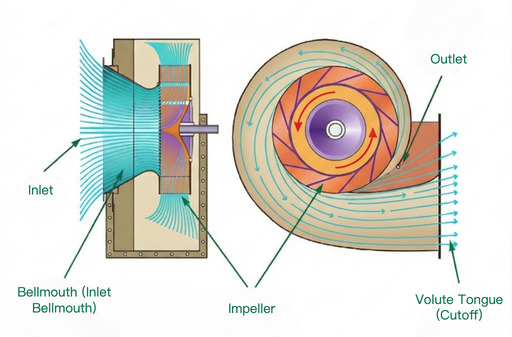
Centrifugal fan working principle (static + animated): the labeled diagram identifies the inlet bellmouth, impeller, volute tongue (cutoff), and outlet, while the animation illustrates the impeller-driven airflow—air enters axially at the inlet, is accelerated and thrown radially outward by the impeller, then the volute collects the flow and converts part of the velocity into static pressure before tangential discharge at the outlet.
A centrifugal fan turns motor power into airflow and pressure through a simple energy path:
Inlet suction: Air enters axially through the inlet cone into the impeller eye.
Energy transfer: Rotating blades add kinetic energy (velocity) to the air.
Radial discharge: Air moves from the hub toward the blade tips and into the casing.
Pressure build-up: The volute/diffuser slows and collects the flow, converting velocity into static pressure.
Outlet discharge: Air exits tangentially into the duct system.
Why this matters: The “velocity-to-pressure” conversion is a key reason centrifugal fans typically perform well in higher-resistance duct systems (filters, scrubbers, cyclones, long runs, multiple elbows).
Main Components (What Engineers Actually Specify)
Impeller: Determines airflow/pressure behavior, efficiency, and dust-handling capability.
Volute (scroll) / diffuser: Converts kinetic energy to pressure and directs the discharge.
Inlet cone & bellmouth: Reduces inlet losses; often critical for stable, quiet operation.
Shaft, bearings, and seals: Reliability core; selection depends on temperature, dust, and duty cycle.
Drive system: Direct-coupled or belt-driven; chosen by speed range, maintenance needs, and layout.
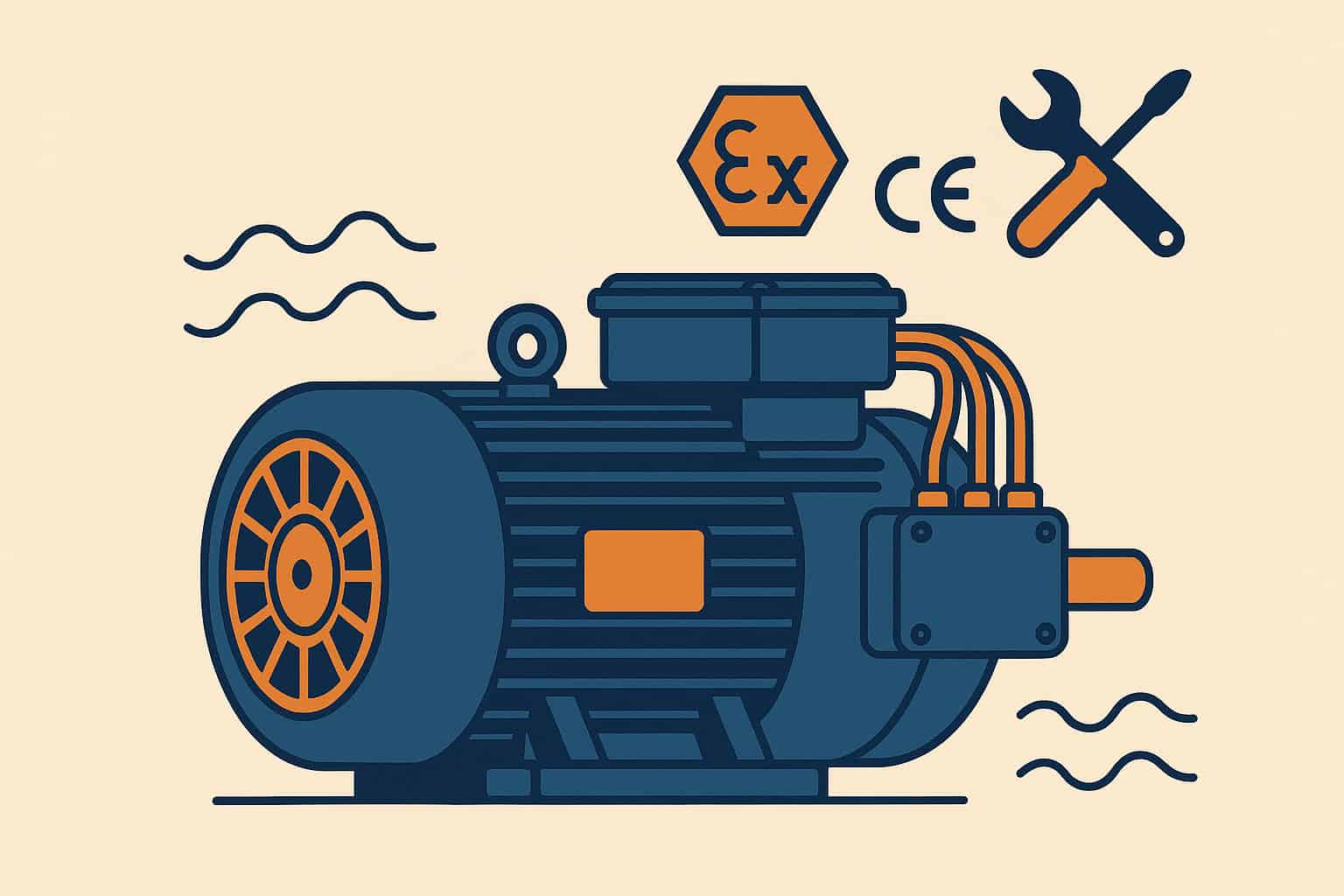
Motor & protection: Standard, high-IP, or explosion-proof motor depending on environment and regulations.
Base, isolators, flexible connectors: Helps control vibration transmission and protect alignment.
Impeller Types and When to Use Them
Blade shape is not a minor detail—it strongly influences efficiency, dust tolerance, and overload behavior:
Backward-curved / backward-inclined: Often high efficiency and stable performance; commonly preferred for industrial ventilation and many dust systems.
Airfoil backward-curved: Typically highest efficiency for clean air; less suitable for sticky dust without protection.
Forward-curved: Compact and common in HVAC; generally less preferred for abrasive dust or harsh industrial duty.
Radial (straight blade): Rugged and tolerant for “dirty air” and particulate; often lower efficiency but strong for abrasion service.
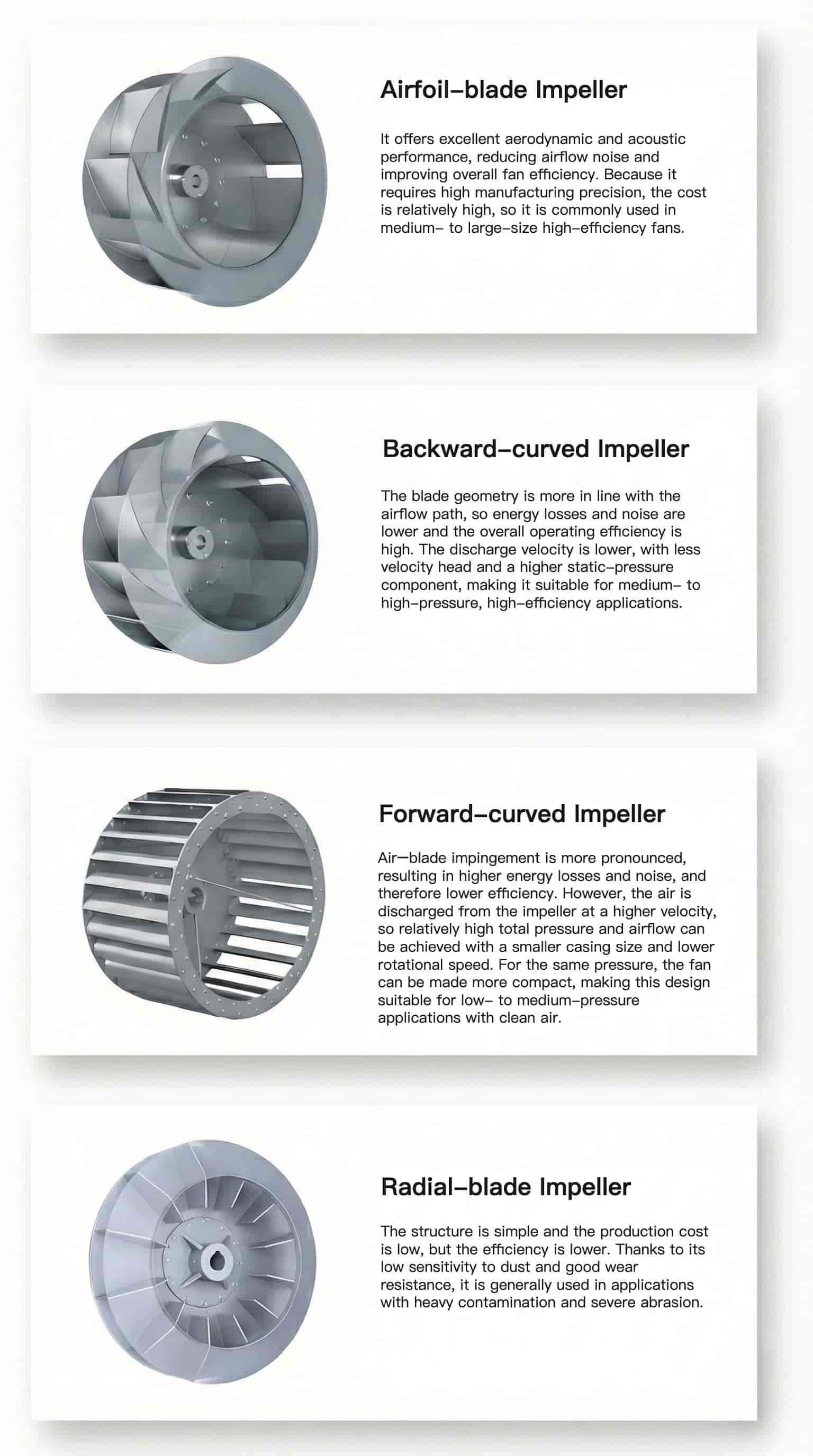
Figure: A quick look at four common centrifugal fan impellers. In general, forward-curved favors compact size, backward-curved favors efficiency, radial handles dusty/abrasive air better, and airfoil is used for high-efficiency applications.
| Impeller type | Typical efficiency | Dust/abrasion tolerance | Common use cases |
|---|---|---|---|
| Backward-curved | High | Medium | Ducted industrial ventilation, many dust collection systems |
| Airfoil backward-curved | Very high (clean air) | Low–Medium | Clean-air ventilation where energy saving is priority |
| Forward-curved | Medium | Low | HVAC, compact equipment, lower pressure duties |
| Radial (straight blade) | Low–Medium | High | Heavy dust/particulate, material handling, abrasive environments |
Mine and dust environments: If air contains abrasive dust, prioritize radial or robust backward-curved designs with wear protection, plus maintenance access for inspection and cleaning.
Key Performance Terms (Avoid Selection Mistakes)
Airflow (Q): Required volumetric flow rate through the system (m³/h or m³/s).
Static pressure (Ps): Pressure needed to overcome duct and equipment resistance (Pa).
Total pressure (Pt): Static + velocity components; often used in fan rating and calculations.
Efficiency (η): Impacts power consumption at the operating point; compare at the same duty point.
Noise: Influenced by speed, turbulence, inlet/discharge conditions, and structure resonance.
Fan curve & system curve: A fan has a performance curve (pressure vs. flow). A duct system has a resistance curve (pressure loss vs. flow). The intersection is the operating point. In real projects, leave reasonable margin (often 10–15% depending on uncertainty) and avoid unstable regions that can cause performance issues or vibration.
Density correction: Air density changes with altitude, temperature, and gas composition. For the same fan speed, pressure and power can change with density. For high-altitude mines or hot gas streams, include density correction in your selection and motor sizing.
Key Features (What Makes Centrifugal Fans Valuable)
Pressure capability: Centrifugal fans are often chosen where the network requires more pressure than basic axial/propeller fans can deliver. Actual pressure range depends on design, speed, and configuration.
Stable operation in ducted systems: Many centrifugal designs handle changing resistance more predictably than simple propeller fans.
Configuration options: Materials (carbon steel, stainless steel, alloys), linings, wear plates, sealing methods, and multiple drive arrangements.
Control flexibility: Works well with VFD, inlet guide vanes, or dampers to match changing demand.
Typical Applications
Mine ventilation (ducted / local / boosting): Used where higher pressure is needed to push airflow through long duct runs, multiple bends, or localized networks.
Dust collection and filtration systems: Common with bag filters, cyclones, scrubbers, and other equipment with significant pressure losses.
Boiler and combustion air: Provides stable pressurized air for burners and combustion control.
Process exhaust: Applied in industrial exhaust networks where resistance and reliability matter.
If you are browsing product series, you can also see: Browse industrial centrifugal fan series.
Selection & Configuration (Practical Step-by-Step)
Use this workflow to reduce “wrong fan for the duct” problems:
Define the duty point: Required airflow (Q) and required pressure (Ps or Pt) at design conditions (temperature, altitude, dust load).
Build a resistance estimate: Include ducts, elbows, transitions, dampers, filters, silencers, and equipment losses. For mines, consider future extensions and layout changes.
Select impeller type: Airfoil/backward-curved for efficiency (cleaner air); radial for heavy dust and abrasion tolerance.
Choose control method: For variable demand, VFD is usually the most efficient control. Dampers can control flow but may waste energy.
Verify motor sizing: Check shaft power at the operating point and add an appropriate safety factor. Choose motor IP rating or explosion-proof certification as required.
Check stability and margins: Confirm your operating point is in a recommended zone and avoid unstable regions (stall/surge risk varies by design).
Plan accessories: Flexible joints, vibration isolation, inlet screens, backdraft dampers, silencers, and sensors (vibration/temperature) as needed.
Material & wear check: For abrasive, corrosive, or hot air streams, verify casing/impeller material (e.g., stainless or lined casing), wear protection, sealing, and maintenance access before finalizing the model.
Quick rule: If your network has high pressure losses (filters, long ducts, many bends), centrifugal fans are often a more reliable choice than simple propeller fans.
Installation Notes (Small Details, Big Performance Impact)
Inlet condition matters: Sharp elbows close to the inlet and poor transitions can increase turbulence, noise, and performance loss.
System effect: Poor inlet/outlet connections can introduce “system effect”, meaning installed performance may be lower than catalog ratings unless the installation matches standardized test conditions.
Foundation and alignment: A stiff base and correct alignment reduce vibration and bearing stress.
Flexible connectors: Helps prevent duct loads from stressing the casing and shifting alignment.
Maintenance access: Reserve space for impeller inspection, cleaning, and bearing service.
Maintenance & Troubleshooting (Actionable Checklist)
Vibration increases: Often caused by impeller build-up (imbalance), bearing wear, misalignment, loosened fasteners, or blade damage. Clean, inspect, and re-balance when necessary.
Low airflow / low pressure: Check blockage, duct leakage, damper position, filter loading, wrong rotation, or excessive inlet losses.
Bearing overheating: Review lubrication, alignment, seal condition, and local cooling/ventilation around bearing housings.
Noise rises suddenly: Commonly linked to inlet turbulence, resonance, loosened structure, or impeller damage.
Recommended routine: Track vibration trend, bearing temperature, impeller cleanliness, belt tension (if belt-driven), and fastener torque. In heavy dust conditions, shorten inspection intervals and keep a cleaning plan.
FAQ
Is a centrifugal fan the same as a radial fan?
In many contexts, “radial fan” refers to the centrifugal family (especially radial-blade designs). In specifications, confirm the impeller type and performance requirement rather than relying on naming alone.
Is a centrifugal fan the same as a centrifugal blower?
The terms often overlap. “Blower” is commonly used when pressure is higher and flow is moderate, but the operating principle remains in the same family.
How do I estimate required fan static pressure?
Add up pressure losses across ducts, bends, transitions, dampers, filters/scrubbers, and equipment at the target flow rate. Then include a realistic margin for uncertainty and future changes.
Backward-curved vs. radial impeller for dust—how to choose?
For heavy abrasive dust, radial designs are typically more tolerant. For cleaner or moderately dusty air where efficiency matters, backward-curved designs are often preferred (with wear protection if needed).
Why does a VFD save energy on fans?
Fan power changes strongly with speed. Reducing speed with a VFD often saves more energy than throttling with a damper, especially under variable demand. As a rule of thumb, airflow is proportional to speed, pressure to speed squared, and power to speed cubed.
Summary
Centrifugal fans are widely used for ducted ventilation and higher-resistance networks in mining and industry. They generate pressure by accelerating air through an impeller and converting velocity into static pressure inside a volute/diffuser. To select correctly, focus on the real duty point (flow + pressure), system resistance, impeller type (dust/corrosion/efficiency), motor sizing and protection, control method (often VFD), and maintainability. With sound installation and routine vibration/temperature-based maintenance, centrifugal fans can deliver stable and efficient long-term operation.
Further Reading
U.S. DOE & AMCA – Improving Fan System Performance (PDF) – A widely cited, authoritative guide to fan systems, covering fundamentals, selection, and the system approach relevant to centrifugal fans.
AMCA – Fan and System Curves (with Fan Energy Index) (PDF) – Explains fan curves, system curves, operating points, and efficiency zones; a perfect companion to the “Fan curve & system curve” section.
AMCA – Minimizing Fan System Effects (PDF) – Details how “system effects” can reduce installed performance versus catalog ratings and provides practical inlet/outlet connection guidance.
AMCA Publication 201 – System Effects: Changing the Curve (PDF) – Shows how real-world inlet/outlet conditions shift the fan curve and operating point in ducted applications.
ANSI/AMCA Standard 99-25 (Standards Handbook) (PDF) – A standards-focused reference for key terms, minimum aerodynamic performance concepts, and common requirements used across AMCA fan standards.
AMCA – Introduction to the Certified Ratings Program (PDF) – Explains AMCA certified ratings and the test/verification framework behind published performance for many centrifugal fan products.
NIOSH – Dust Control Handbook (Industrial Minerals Mining) (PDF) – Government guidance on dust control in mining, including ventilation concepts and fan-related airflow paths that support mine applications.
CDC (NIOSH) – Local Exhaust Systems (PDF) – Authoritative guidance on local exhaust ventilation design and placement, clarifying how fans are applied within exhaust systems.
Axial vs. Centrifugal Fans: Complete Guide – Practical comparison and selection logic for ducted systems.