


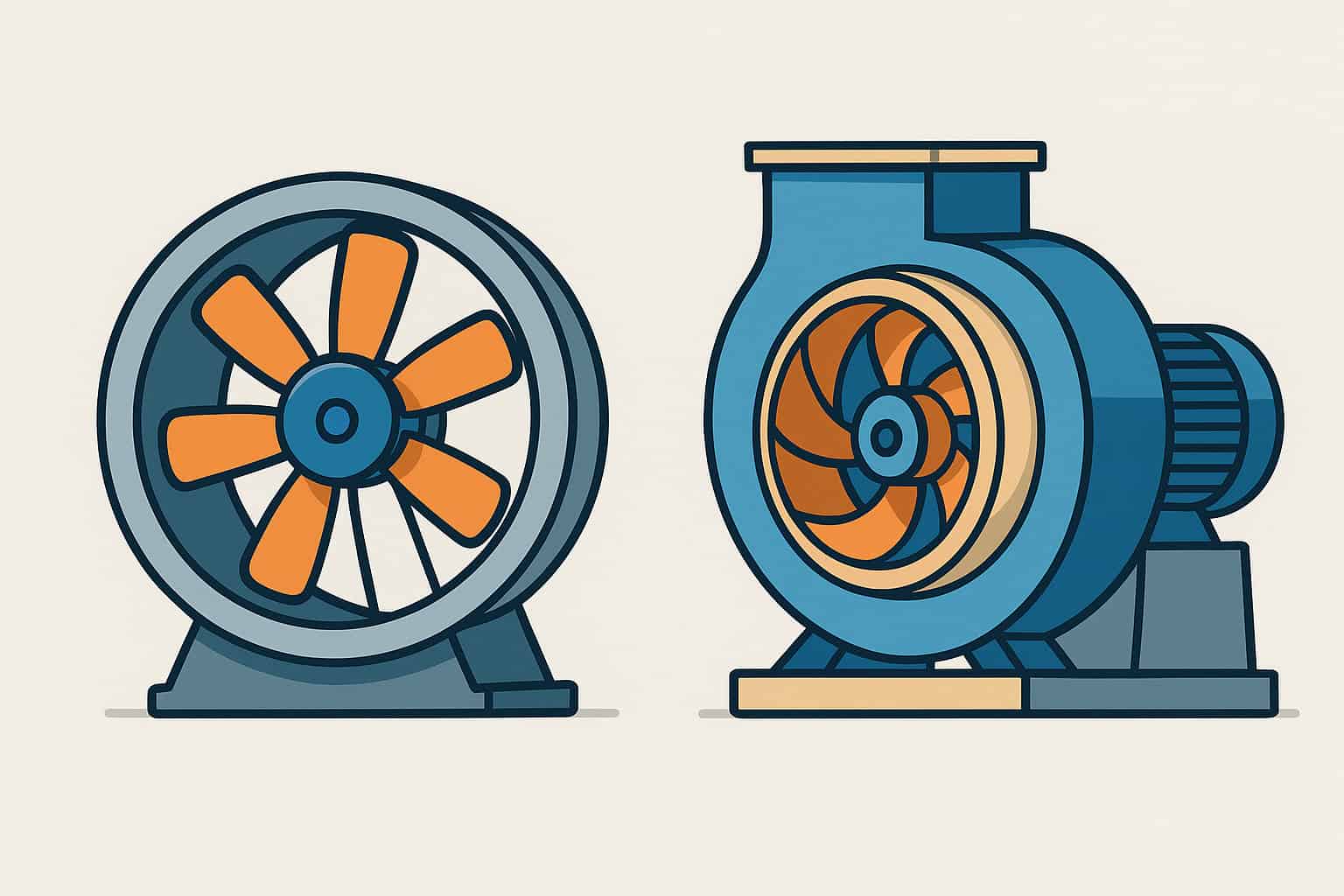
An axial flow fan is a type of mechanical fan where the air flows parallel to the axis of rotation of the blades. It is used to move large volumes of air at relatively low static pressures, typically in environments where high airflow is required but where high static pressure is not necessary. These fans are found in various industrial and commercial applications, particularly in ventilation systems for tunnels, mines, and industrial spaces.
Why Do We Need Axial Flow Fans?
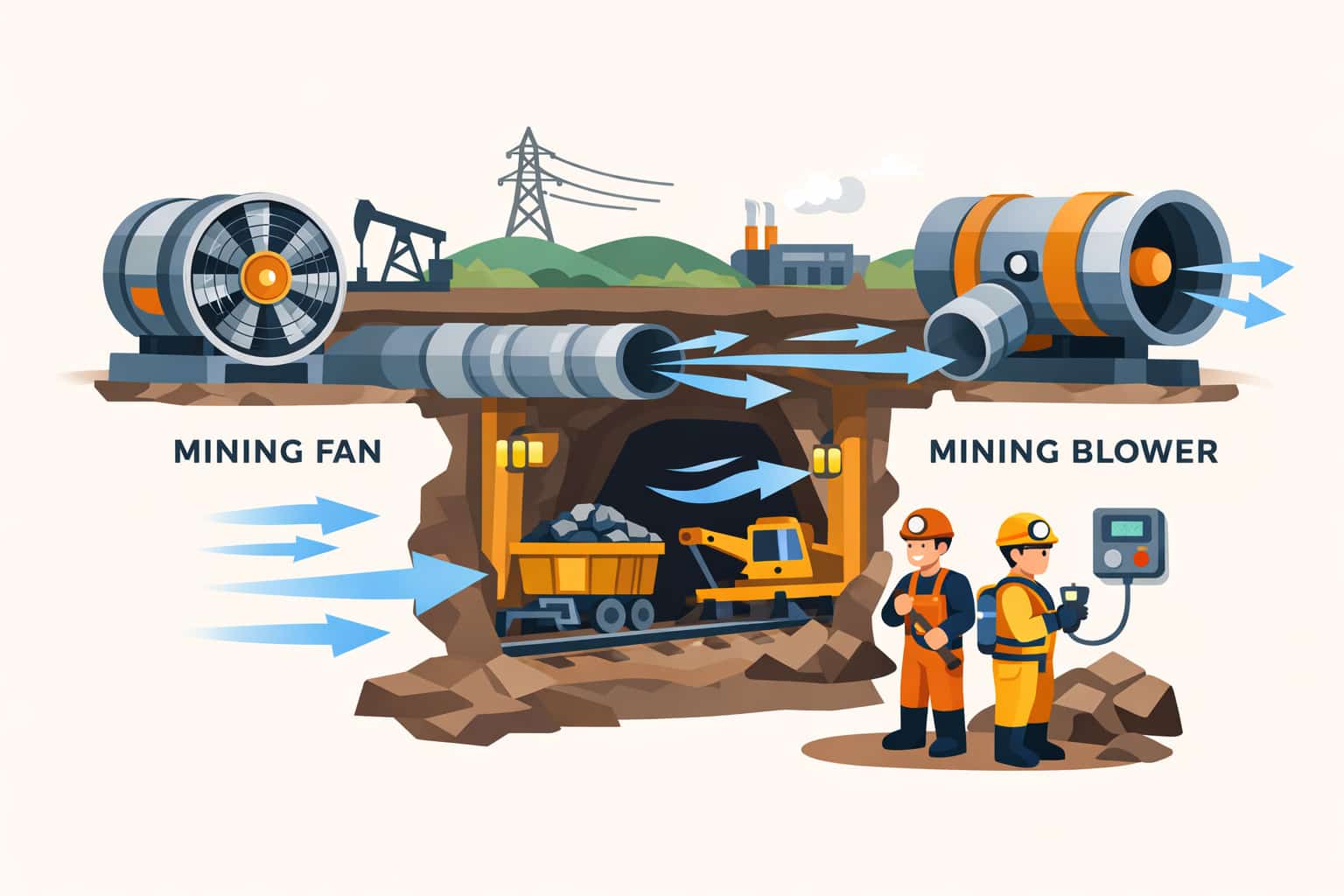
Axial flow fans are essential for air movement in spaces that require continuous, high-volume airflow. Unlike centrifugal fans, which are better suited for high-pressure applications, axial fans are designed for environments where space is limited and low pressure is required. For example, in mining operations, these fans are crucial for ventilating tunnels and removing harmful gases, ensuring a safe and breathable environment for workers.
Axial Flow Fan Components & Airflow Direction
Main components (typical):
Inlet cone / bellmouth (if equipped): reduces inlet losses and smooths incoming flow.
Impeller (rotor) + blades: adds energy to the air by aerodynamic lift, creating a pressure rise.
Hub & shaft: transmit torque from the motor to the impeller.
Casing / duct (tube): guides the straight-through airflow path and supports the structure.
Motor & drive (direct/belt): provides rotational power.
Stator / guide vanes (vane-axial designs): reduce swirl and improve outlet flow uniformity.
Safety guard / grille: prevents debris ingestion and protects personnel.
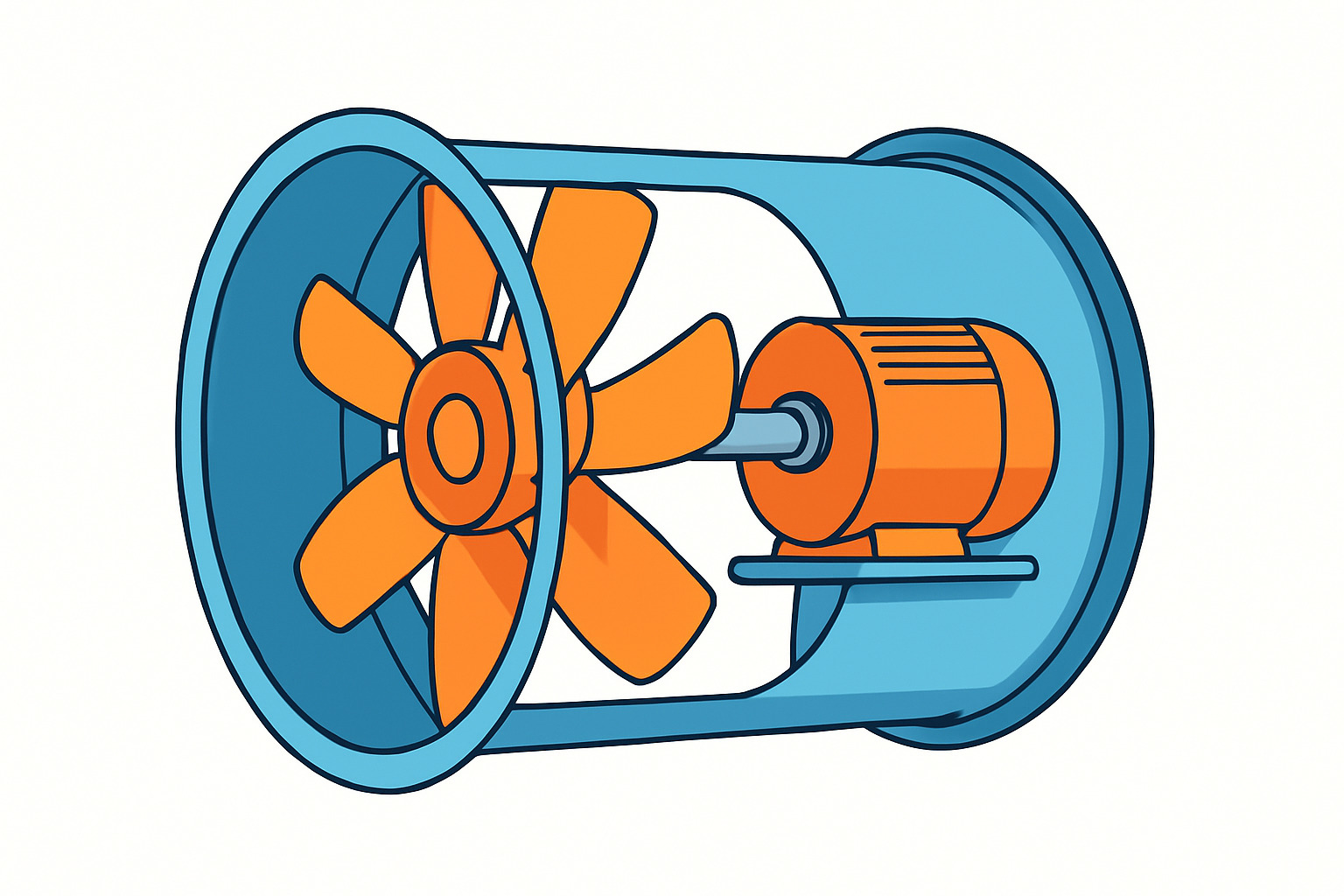
Figure 1. Axial flow fan overview (animated): a tube-axial (inline) fan showing the main components and a schematic straight-through airflow pattern along the fan axis. Note: this is a simplified illustration; actual internal structure and flow details vary by design (tube-axial vs vane-axial), size, and application.
How the airflow moves (direction explained):
Air enters parallel to the fan axis (straight-through).
The rotating blades accelerate the air and raise total pressure (not “centrifugal throwing”).
A swirling component may appear behind the impeller.
Guide vanes (if present) straighten the flow and recover useful static pressure.
Air exits in the same axial direction, suitable for high-volume ventilation.
Working Principle
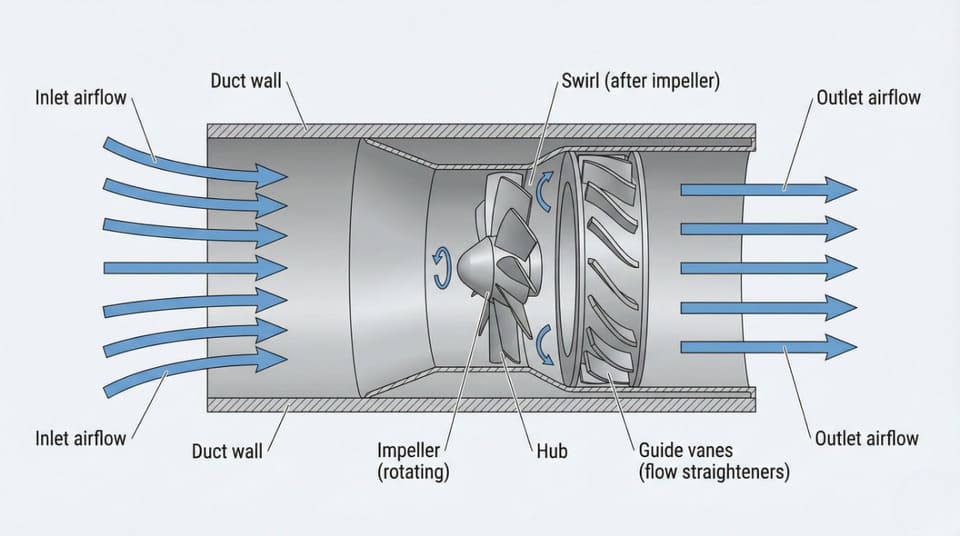
Figure 2. Axial flow fan working principle for ventilation systems: impeller-driven airflow with swirl reduction by guide vanes to deliver stable outlet airflow.
The working principle of an axial flow fan is based on pressure differential created by the rotation of the impeller blades. When the motor turns the impeller, air is drawn into the fan, accelerated by the rotating blades, and pushed forward along the fan's axis. The flow remains mostly linear, with the air exiting at the same axial direction.
In some configurations, guide vanes are used downstream to reduce airflow swirl and increase efficiency by straightening the flow of air. This minimizes energy losses due to turbulence and maximizes the fan's overall performance. The impeller blade design plays a crucial role in determining the airflow rate, pressure increase, and overall energy efficiency.
Axial Flow Fan Types and Classifications
In practice, axial fans are classified in more than one way. The most useful approach is to start with the housing/installation type, then add whether the fan uses downstream guide vanes (stators) to manage swirl.
1) By Housing and Installation (Most Common)
A. Propeller / Panel / Wall Axial Fan (Free-Delivery Axial)
A propeller-type axial fan is typically installed in a wall opening, panel frame, or short housing. It works best in low-resistance systems where air can enter and discharge freely.
Best for: general exhaust, workshops, warehouses, cooling/heat extraction.
Note: performance drops quickly when connected to long ducts or high system resistance.
B. Tube-Axial / Duct / Inline Axial Fan
A tube-axial fan places the impeller inside a cylindrical casing (tube/duct) and is designed to be installed in-line with ductwork or long roadways.
Best for: ducted supply/exhaust, tunnel and auxiliary mine ventilation, systems with moderate resistance.
Figure 1 in this article shows a typical tube-axial (inline) fan overview.
2) By Guide Vanes (Key Aerodynamic Difference)
A. Tube-Axial (No Stator / No Guide Vanes)
Without downstream guide vanes, the air leaving the impeller may carry more swirl (a rotational component). The structure is simpler and often more cost-effective.
B. Vane-Axial (With Downstream Guide Vanes / Stator)
Vane-axial fans include rear guide vanes (stators) behind the impeller. These vanes reduce swirl, improve outlet flow uniformity, and can recover useful static pressure depending on the design and operating point.
Figure 2 illustrates the airflow direction and how guide vanes can reduce swirl for a more stable outlet flow.
3) By Control Method (How the Duty Is Adjusted)
Fixed-pitch axial fan: blade angle is fixed; flow is usually controlled by speed (VFD) or dampers.
Adjustable/variable-pitch axial fan: blade angle can be adjusted (manual or automatic) to match changing system resistance and widen the operating range.
4) By Blade Aerodynamics (Efficiency and Noise)
Airfoil blades: typically higher efficiency and lower noise at the same duty point, but require higher manufacturing precision.
Standard/plate blades: robust and cost-effective for general ventilation.
Practical Selection Tip (Simple Rules)
Long ducts / long roadways / higher resistance: choose tube-axial or vane-axial (when better outlet uniformity or higher pressure efficiency is needed).
Free intake and discharge with minimal ducting: choose propeller/panel axial.
Wide operating range or varying resistance: consider variable-pitch (or speed control with a suitable fan design).
Note: Some projects use axial fan variants (e.g., higher-pressure vane-axial, contra-rotating, or multi-stage designs). Final selection should follow the system curve and required duty point.
Key Features of Axial Flow Fans
1. High Flow Rate & Low Static Pressure
Axial flow fans are known for their high volumetric airflow and low static pressure characteristics. This makes them ideal for large spaces requiring constant, uniform ventilation. However, because they operate at lower static pressures than centrifugal fans, they are less effective in systems where high resistance is present, such as long ducts with significant bends. In environments where high flow rates are crucial but high static pressure is not required, axial flow fans are the most efficient choice.
2. Compact & Efficient Design
Axial fans have a relatively simple and compact design compared to other types of fans. The straight-through airflow design reduces the size of the fan casing and impeller, making them more efficient for specific applications. This compactness makes them ideal for use in places with space limitations such as mines, tunnels, and industrial plants. Their ability to produce large amounts of airflow without taking up much space is a significant advantage.
3. Noise & Vibration Management
Despite their high flow rates, axial fans can sometimes generate more noise and vibration compared to centrifugal fans. This can be mitigated by using multi-blade impellers and incorporating sound-dampening technologies. For demanding applications, such as in mines or factories, vibration monitoring and routine maintenance are critical for ensuring smooth and reliable operation. Axial fans equipped with anti-vibration mounts and vibration isolation pads can help minimize noise and extend their lifespan.
Applications of Axial Flow Fans
Axial flow fans are used in various industries where large volumes of air need to be moved with low static pressure. Below are some key applications:
1. Mining and Tunnel Ventilation
In mining and tunnel environments, where fresh air circulation is critical, axial fans are widely used as part of mining ventilation solutions to remove harmful gases, dust, and heat and to maintain safe working conditions underground. Due to their high airflow capacity and efficient straight-through flow path, axial flow fans are often considered the best axial fan for mining ventilation in low-to-medium resistance layouts such as headings, intake airways, and auxiliary ventilation systems. For example, in coal mining, effective airflow helps dilute and exhaust methane while controlling dust and heat buildup. In practice, the fan selection should match required airflow and the mine network resistance, and the installation should minimize leakage and recirculation to maintain ventilation effectiveness.
2. Industrial Ventilation
Axial fans are used to provide cooling and ventilation in large industrial plants, warehouses, and production facilities. Their ability to handle high flow rates with minimal resistance makes them perfect for spaces that need constant air movement but do not require high static pressure. For example, in large manufacturing plants, axial fans are used to remove heat and excess moisture, reducing the risk of equipment failure and creating a safe, comfortable environment for workers.
Axial fans are also commonly used in chemical plants and pharmaceutical manufacturing where ventilation and air exchange are crucial to preventing hazardous conditions like toxic gas buildup or airborne contaminants.
3. HVAC Systems
For heating, ventilation, and air conditioning (HVAC) systems, axial flow fans are used to move large amounts of air. They are particularly effective in systems that require consistent airflow without excessive ductwork or high-pressure environments. In large commercial buildings and industrial facilities, axial fans are used to maintain air circulation and ensure temperature regulation across vast spaces like shopping malls, gymnasiums, or manufacturing floors. Axial fans are also ideal for air handling units (AHUs) and roof-top units (RTUs) in HVAC systems due to their energy efficiency and ability to circulate large volumes of air.
How to Choose the Right Axial Flow Fan
Selecting the right axial flow fan depends on your specific airflow needs. Here are some key considerations:
Airflow Requirements: Determine the volume of air that needs to be moved and the desired velocity. The fan should be capable of meeting both the required flow rate and the environmental conditions. For example, in a large tunnel ventilation system, the fan may need to push air at a higher velocity to ensure fresh air reaches the deepest parts of the tunnel.
Static Pressure: While axial fans are well-suited for low-pressure applications, make sure the fan's capabilities match the system’s pressure conditions. In high-resistance systems, consider a centrifugal fan instead. Ensure the fan's operating range aligns with your application.
Noise and Vibration Control: If the system is located in a noise-sensitive environment, consider using fans with multi-blade designs and vibration dampeners. High-efficiency fans may also require sound-dampening technologies to reduce operational noise. In applications where minimal noise is crucial (such as hospitals or office buildings), choosing a fan with low noise output is essential.
Energy Efficiency: Choose a fan that fits your airflow and pressure needs to ensure optimal performance and energy efficiency. Over-sizing a fan may lead to unnecessary energy consumption, while undersizing it could cause inadequate airflow. Additionally, using variable frequency drives (VFDs) can help optimize energy usage.
Maintenance Tips for Axial Flow Fans
Proper maintenance ensures the longevity and efficiency of axial flow fans. Here are some key maintenance practices:
Cleaning the Blades: Dust and debris can accumulate on the blades, reducing airflow efficiency. Regular cleaning helps maintain optimal fan performance. This is especially important in industrial settings where particles and dust can quickly clog the fan blades.
Checking Bearings and Lubrication: Bearings should be inspected for wear, and regular lubrication is necessary to reduce friction and prevent premature failure. Insufficient lubrication can lead to overheating and early wear of bearing components.
Monitoring Vibration Levels: Install vibration sensors to detect abnormal vibrations, which could indicate misalignment, imbalance, or component wear. Regular vibration checks can prevent unplanned downtime. In mining or industrial plants, vibration monitoring systems are essential to predict failures before they occur, reducing maintenance costs.
Inspecting for Corrosion: Fans used in harsh environments, such as in mining or chemical plants, should have corrosion-resistant coatings. Regular inspections for corrosion help ensure that the fan operates safely and effectively.
Conclusion
Axial flow fans are essential components in a variety of industrial and ventilation systems, providing high airflow with relatively low energy consumption. While they are ideal for large-scale, low-pressure applications, proper selection, maintenance, and noise and vibration control are necessary to optimize their performance. By understanding the fan’s working principles and features, industries can effectively implement axial flow fans in their systems for efficient and safe operation.
References / Further Reading
Fan Performance Characteristics of Axial Fans (Aerovent “Fan Engineering”, PDF) — Axial-fan-specific performance behavior (operating range, pressure capability, and typical performance characteristics) to support the article’s “how axial fans work” and “performance” sections.
Fan and System Curves with Fan Energy Index (AMCA, PDF) — Authoritative explanation of fan curves vs system curves and the duty point, strengthening the “selection” and “curve reading” parts of the article.
Improving Fan System Performance: A Sourcebook for Industry (U.S. DOE / NREL, PDF) — Engineering reference on fan fundamentals and system-level selection/efficiency, useful for making the “selection” and “applications” sections more rigorous.
Basics of Fan Noise (AMCA, PDF) — Practical foundation for fan noise concepts and ratings, supporting the article’s “noise & vibration” discussion.
Axial vs. Centrifugal Fans: Complete Guide (Mining-Fan.com) — A focused comparison that complements this article by clarifying where axial fans excel vs. where centrifugal fans are the better choice.
