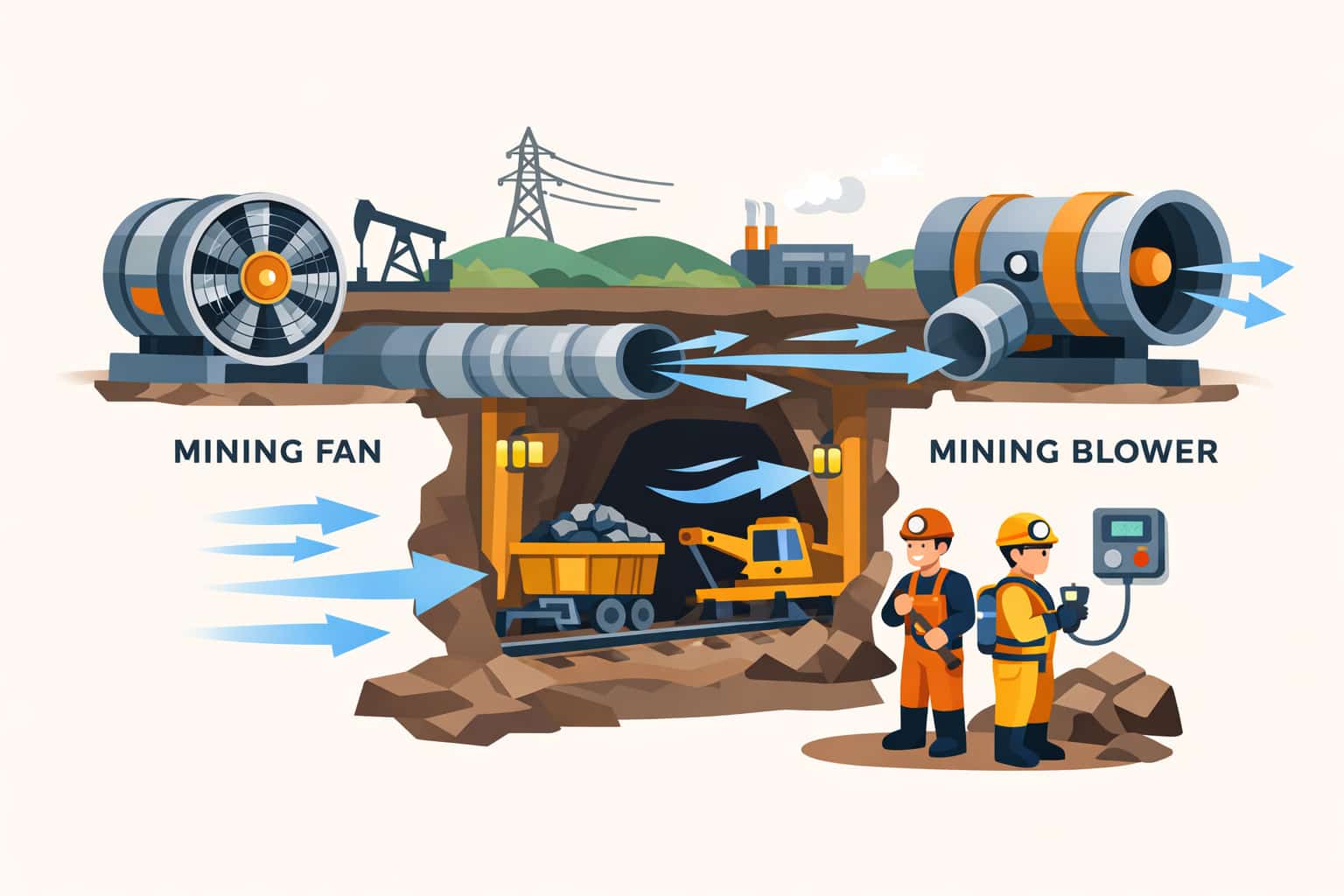
auxiliary ventilation fan
An auxiliary ventilation fan is the workhorse for delivering air to development headings, raises, and other localized underground work areas. Unlike main and booster fans that manage the overall mine network, an auxiliary unit must overcome the resistance of ducting—which means the correct selection is almost always defined by end-of-duct performance, not by free-air airflow.
In real mines, auxiliary fan performance is shaped by three practical issues: duct pressure loss, duct leakage, and changing resistance. As duct length grows and additional bends/reducers are installed, static pressure demand increases. If duct joints are poor, a meaningful portion of airflow can leak before it reaches the face. The result is a common complaint: “the fan is running, but the face feels starved.”
To size an auxiliary ventilation fan properly, start with the duty point:
- Q (airflow): specify the required airflow where it matters (typically the end of duct at the face), in m³/s or m³/min.
- Ps (static pressure): estimate total static pressure including duct length, diameter, bends, reducers, fittings, and realistic leakage condition.
- Margin: allow practical reserve for planned heading advance, duct extension, and expected deterioration of duct integrity over time.
Configuration also matters. Forcing ventilation (blowing fresh air to the face) is common for direct delivery, while exhausting ventilation (extracting contaminants) may be used where contaminant control benefits outweigh duct leakage challenges. Either way, the fan must operate in a stable region of its curve. Oversizing without control can create noise/vibration and unstable operation when resistance shifts.
A VFD is often the most practical tool for auxiliary ventilation: it lets you adjust speed to maintain target airflow as ducts extend, reduces energy waste, and helps keep the fan away from problematic operating zones. Combine correct sizing with disciplined duct management (better joints, fewer sharp bends, appropriate duct quality), and auxiliary ventilation becomes predictable rather than reactive.
Contact Us
Contact Us