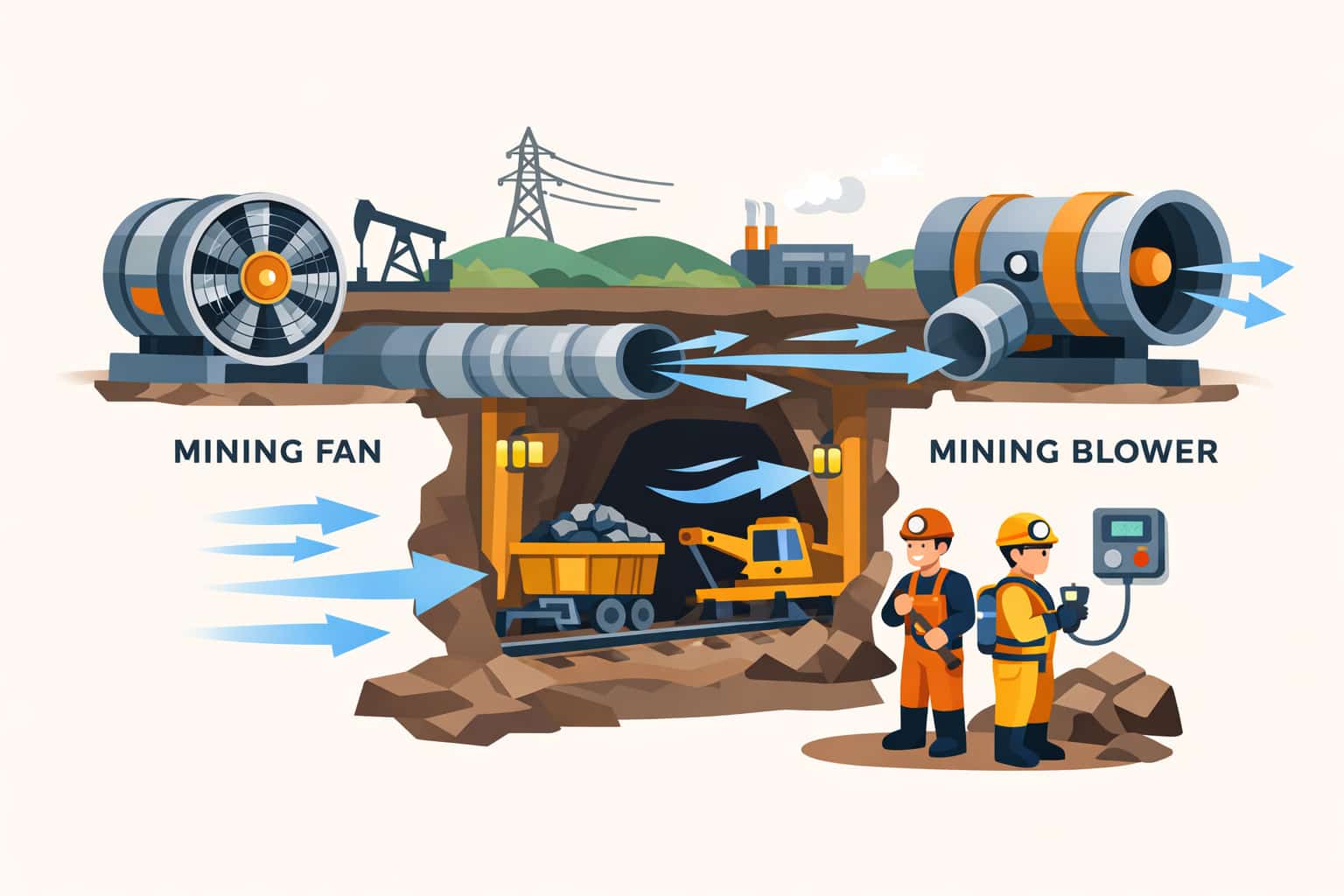
duct fan mining
A duct fan in mining is an auxiliary ventilation fan designed to connect to flexible or rigid ducting and deliver airflow to development headings, raises, and localized work areas. Because duct systems are highly resistive compared with open-air applications, mining duct fans are typically selected for their ability to maintain airflow under higher static pressure and changing resistance as the heading advances.
The practical performance requirement is not “maximum airflow.” It is end-of-duct delivery. As duct length increases, pressure losses rise quickly. Each bend, reducer, and poor transition adds resistance and turbulence. Leakage through damaged joints and worn duct fabric can also reduce delivered airflow before it reaches the face. As a result, a duct fan must be evaluated at its Q@Ps duty point under realistic system conditions, not at free-air or near-zero-pressure ratings.
Mining duct fans are commonly used in two configurations:
- Forcing ventilation: the fan blows fresh air through the duct to the face for direct delivery.
- Exhausting ventilation: the fan extracts contaminated air through the duct to control dust and gases when leakage control is strong.
Control and stability matter as much as capacity. Oversizing can create noise and vibration, while undersizing can cause chronic face airflow shortages. VFD control provides flexibility to match speed to the required duty range and maintain stable operation as resistance changes. System improvements—better duct routing, fewer sharp bends, tighter sealing, and appropriate duct diameter—often deliver the biggest performance gains per dollar.
Bottom line: a mining duct fan is a system-matching solution. When selected by realistic Q@Ps and supported by good duct practices, it provides reliable face ventilation and reduces operational surprises as headings advance.
Contact Us
Contact Us