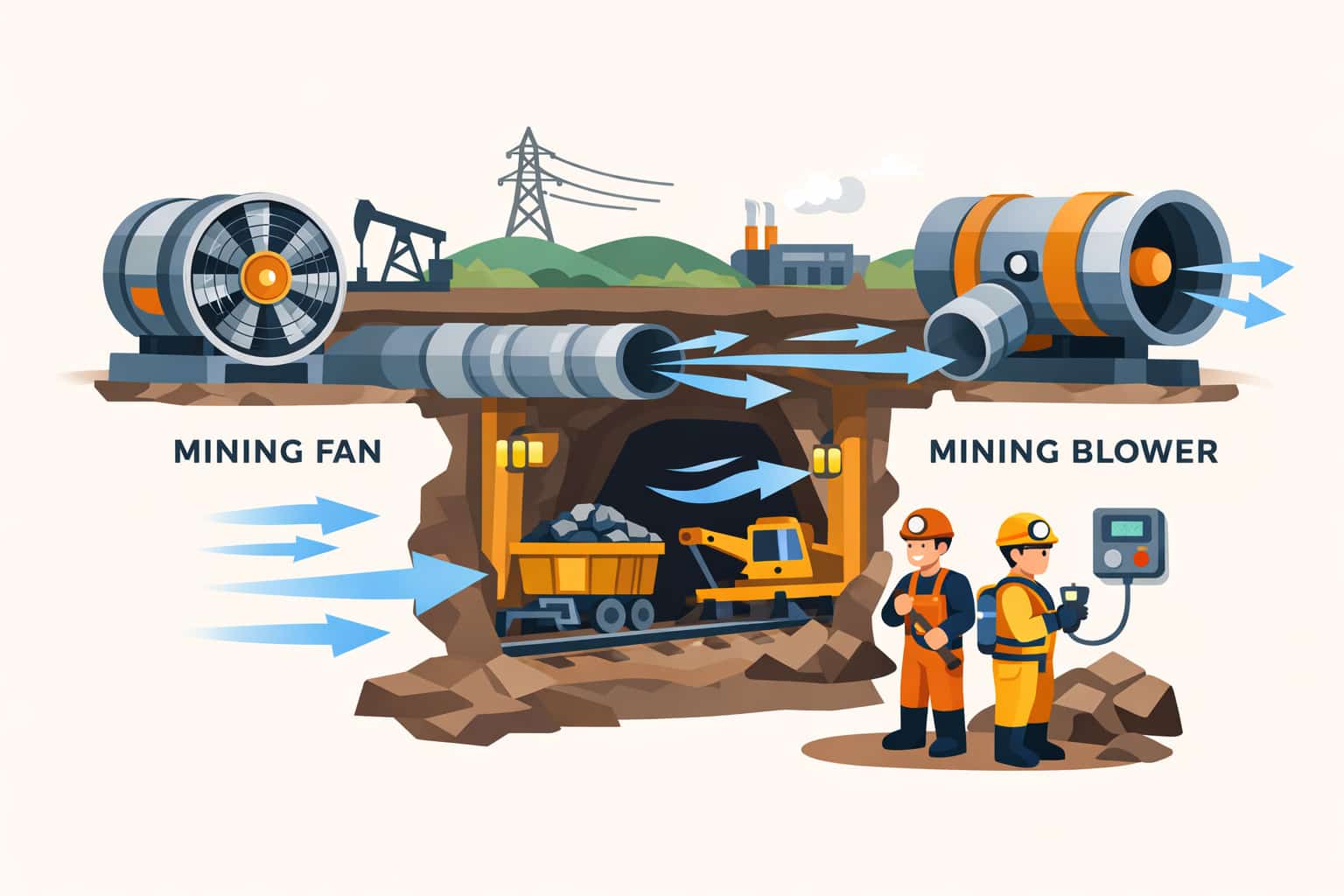
exhausting ventilation
Exhausting ventilation is a duct ventilation method where an auxiliary fan draws air from a development heading and exhausts it through ducting, helping remove contaminants from the face. In certain mining conditions, exhausting ventilation can support better contaminant control by pulling polluted air away from workers—provided the duct system is designed and maintained for effective capture at the face.
The practical challenge is that exhausting systems can be highly sensitive to duct leakage and duct integrity. Leaks along the duct can draw in surrounding air, reducing the amount of contaminated air captured at the face. This means the system may show airflow in the duct, yet still underperform in terms of face contaminant control. For this reason, selection must consider both the required airflow (Q) and the required static pressure (Ps) to maintain an effective operating point under real duct conditions.
When specifying exhausting ventilation, focus on:
- Capture at the face: define the target airflow where extraction is required, not just fan outlet conditions.
- Duct losses: long ducts, bends, and fittings raise Ps demand and shift the operating point.
- Leakage control: high-quality ducting and tight joints are critical to maintain effective extraction.
- Control: a VFD helps adjust speed as resistance changes, supporting stable extraction performance.
As with forcing ventilation, avoid selecting by a “free-air” rating measured near 0 Pa. Underground exhausting systems rarely operate at low resistance, and the duty point can shift significantly as headings advance. Operational verification should include measurement and observation of whether extraction is effective at the face, not just whether the fan is running.
Bottom line: exhausting ventilation can be a strong option for contaminant control, but only when duct integrity is high and the fan is selected to meet Q@Ps under realistic, changing mine conditions.
Contact Us
Contact Us