fan performance curve
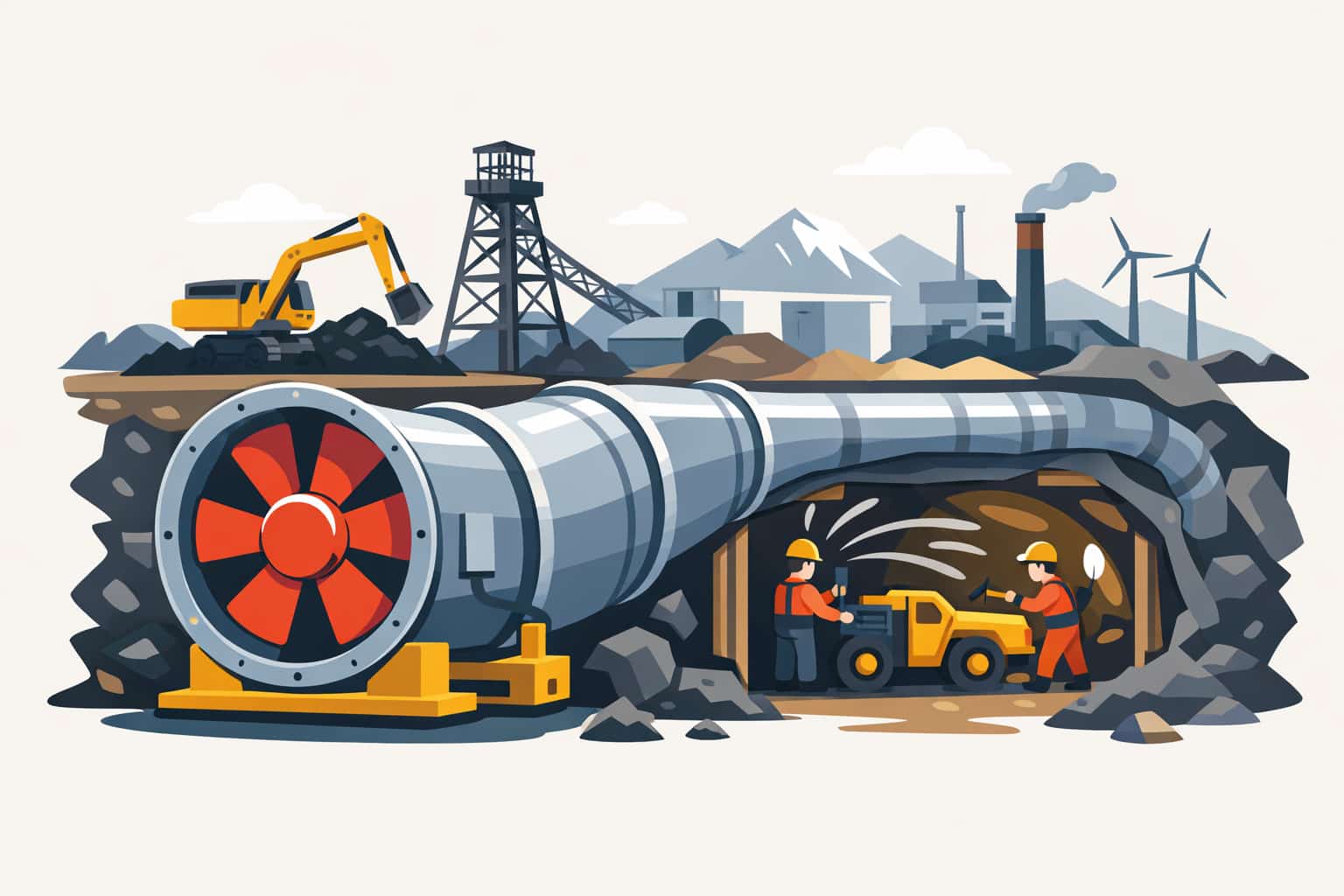
A fan performance curve is a fundamental tool in mine ventilation engineering, describing how a fan’s pressure, flow, power and efficiency vary across its operating range. For mining applications, understanding the fan performance curve is essential for selecting and operating main fans, booster fans and auxiliary mining fans. When plotted correctly and compared with the system resistance curve of the mine, the fan performance curve indicates the actual duty point at which the fan will run and whether it can deliver the required airflow under all operating conditions.
The standard fan performance curve plots total pressure on the vertical axis and volume flow rate on the horizontal axis. Additional curves for input power and efficiency are often drawn on the same graph. For each rotational speed, the curve shows how pressure decreases as flow increases, reflecting the physics of the fan and its aerodynamic design. Manufacturers obtain these curves through standardized fan testing and publish them in catalogues or technical data sheets for axial and centrifugal mining fans.
In a mine ventilation system, the fan performance curve must be considered together with the system resistance curve, which represents pressure losses through shafts, roadways, regulators and equipment. The intersection between the fan curve and the system curve gives the duty point at which the fan will naturally operate. If this point lies near the fan’s best efficiency point, the fan will run efficiently, with stable airflow and reasonable power consumption. If the intersection is far from the best efficiency point, the fan may suffer from stall, high noise or excessive energy use.
Fan performance curves are also used to evaluate how changes in speed, density or system resistance will affect mine ventilation. Affinity laws allow engineers to estimate new pressure and flow values when fan speed or air density changes. When system resistance increases due to additional workings or blockage, the intersection with the fan curve moves, reducing airflow. By studying the fan performance curve, ventilation engineers can decide whether to adjust fan speed, change fan pitch, add booster fans or upgrade to a different model. Proper use of fan performance curves ensures reliable, efficient and safe operation of mine ventilation fans throughout the life of the mine.
Contact Us
Contact Us