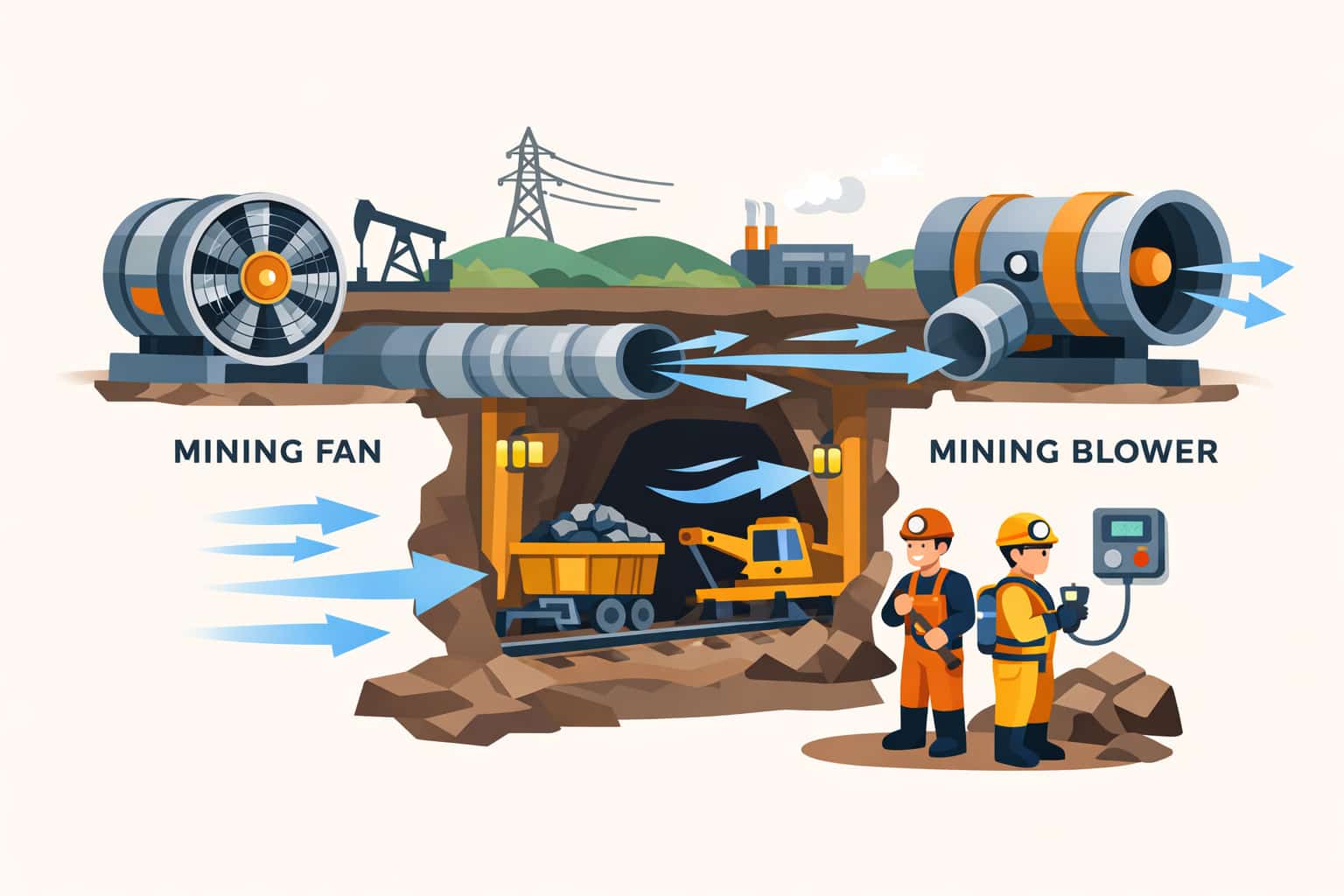
forcing ventilation
Forcing ventilation is a duct ventilation method where an auxiliary fan blows fresh air through a duct directly to a development heading or working face. In many mines, forcing ventilation is widely used because it provides a clear objective: deliver fresh air where it is needed most, and maintain a controllable airflow path through the duct.
However, forcing ventilation succeeds only when the system is sized and maintained for the real duty point. The fan must deliver the required end-of-duct airflow at the required static pressure (Ps). As duct length increases, bends add losses, and duct condition changes, required Ps rises and the operating point shifts. That is why selecting by free-air airflow or by the label “blower” is risky; the correct selection is by Q@Ps on the performance curve under realistic duct assumptions.
Key factors that determine forcing ventilation performance include:
- Duct diameter and length: larger diameter reduces friction losses, but space and handling constraints may apply.
- Bends and fittings: sharp bends can add significant pressure loss and should be minimized.
- Duct leakage: poor joints and damage reduce delivered airflow at the face.
- Control strategy: a VFD helps maintain airflow as resistance changes with heading advance.
In practice, forcing ventilation is often the first choice when direct fresh-air delivery is the priority and duct routing is manageable. Performance should be verified by measurement at the duct outlet and tracked as ducts extend. When airflow drops, the best response is typically to fix the system first—seal joints, reduce losses—then confirm whether additional pressure capability is required.
Bottom line: forcing ventilation is effective and predictable when it is treated as a system-matching problem, sized by duty point, and supported by disciplined duct management.
Contact Us
Contact Us