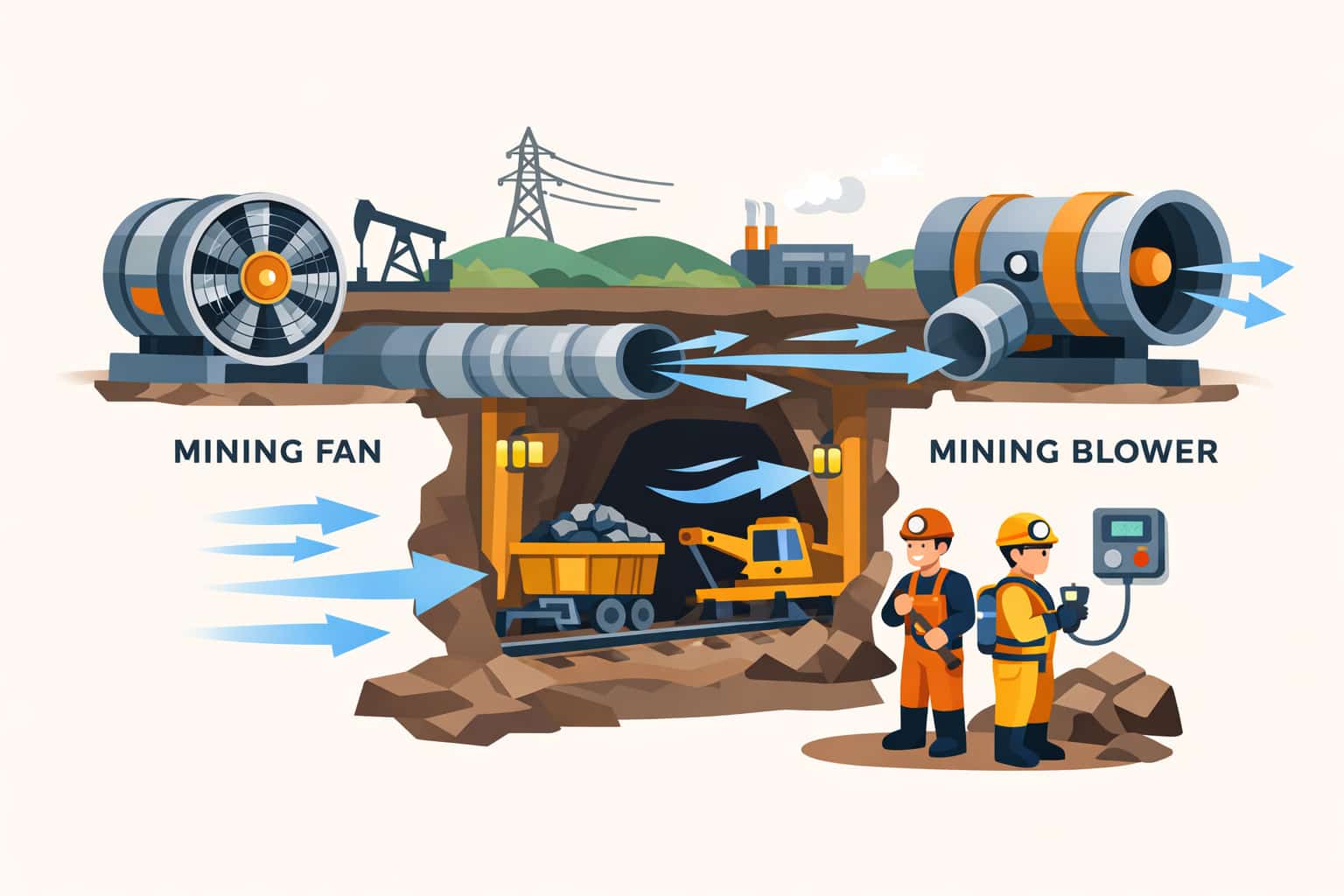
ventilation airflow (Q)
Ventilation airflow (Q) is the volumetric flow rate of air delivered by a ventilation system, typically expressed as m³/s or m³/min. In mining, Q is not just a “fan number”—it is a planning and safety variable used to support gas dilution, dust control, heat and humidity management, and acceptable working conditions. The key is defining where Q is required: at the shaft, in a district, or at the end of duct for a development heading.
In ducted auxiliary ventilation, the most meaningful Q is often the airflow at or near the face. A fan may produce high airflow at low resistance, but once duct losses and leakage are included, the delivered airflow can be much lower. That is why airflow must be specified together with static pressure (Ps) at the duty point. In practical terms, the fan must meet Q@Ps in the real system, not in free-air conditions.
To apply Q correctly in selection and operation:
- Use the ventilation plan to define required airflow by location and purpose (dilution, dust, heat).
- Specify the measurement point (face, duct end, regulator, or main airway) to avoid misleading comparisons.
- Pair Q with Ps so the duty point is clear and the correct fan curve can be selected.
- Verify with measurement because system resistance and leakage change as the mine develops.
Operationally, tracking airflow trends is just as important as initial sizing. If Q drops as headings advance, it usually indicates increased resistance (longer duct, more bends) or increased leakage. Using a VFD can help maintain target airflow by adjusting speed as conditions change, but duct management remains essential. Bottom line: Q is the “what” of ventilation, but only becomes reliable when defined at the right location and matched with Ps at the duty point.
Contact Us
Contact Us