
Underground mine ventilation is essential to safe and efficient mining operations. It is not only about supplying fresh air underground. In practice, it also involves controlling airflow, diluting hazardous gases, reducing dust and diesel particulate matter (DPM), managing heat in deep workings, and supporting more stable underground production conditions.[1][2][3]
In many mines, ventilation is also one of the largest operating energy users. Research on mine fan assemblages reports that ventilation systems may account for roughly 25%–40% of total mine energy costs and 40%–50% of total mine energy consumption, which is why ventilation should be treated as a system-efficiency issue rather than only an air-supply task.[4]
What Is Underground Mine Ventilation?
Underground mine ventilation is the organized movement of air through underground workings to maintain acceptable air quality and working conditions. Fresh air must reach active headings, production areas, and other underground zones, while contaminated air must be directed out through return routes. In addition to supplying oxygen, ventilation supports methane control, dust reduction, diesel emission dilution, and heat management.[1]
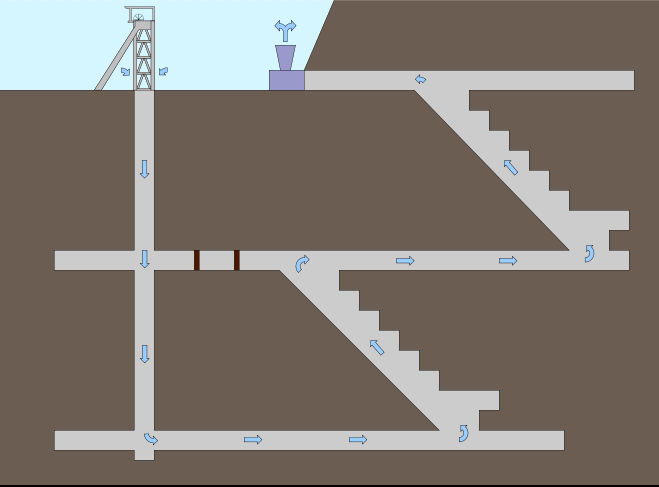
Figure 1. Simplified underground mine ventilation airflow diagram showing intake airflow, underground distribution, and return airflow paths. Source: Wikimedia Commons (via Wikipedia).
This means underground mine ventilation should be understood as a system-level engineering task rather than a single equipment choice. Air quantity, air route design, resistance, leakage, monitoring, and underground operating conditions all affect overall ventilation performance.[1][5]
Key Challenges in Underground Mine Ventilation
High Energy Consumption
Ventilation systems often consume a major share of mine energy because air has to move through long underground routes and overcome network resistance. In many cases, the problem is not simply a lack of airflow, but inefficient airflow delivery. Excessive pressure loss, leakage, poor balancing, and inflexible operating conditions can all increase fan power without improving ventilation where it is actually needed.[4]
Hazardous Gas, Dust, and DPM Exposure
Underground ventilation must also control airborne contaminants generated by mining activity and diesel-powered equipment. NIOSH states that diesel engines are major contributors to underground aerosols and gases in coal and metal/nonmetal mines, and that mines need a comprehensive integrated control program. Effective airflow distribution is therefore central to reducing exposure in active underground zones.[3]
Heat Stress in Deep Underground Mines
As mines go deeper, heat becomes a more serious design factor. MSHA notes that deep underground mines are hot work sites because heat radiates from surrounding rock and hot groundwater adds to the underground heat load. MSHA also states that ventilation is one of the main methods of reducing the effect of rock temperature underground, although additional cooling may sometimes be needed.[2][6]
Changing Layouts and Dynamic Air Demand
Underground airflow demand does not stay constant. New headings, changing production zones, longer routes, and equipment movement all affect where air is needed and how much should be delivered. This is why modern mines increasingly look at adaptive control strategies instead of fixed ventilation settings. Recent research describes Ventilation on Demand (VoD) as a method used to maintain safety while reducing fan energy consumption by adjusting fan power according to changing underground ventilation parameters.[5]
Practical Mine Ventilation Solutions
A practical underground mine ventilation solution should be based on actual operating conditions rather than a fixed template. In most projects, this means looking at required air quantity, pressure loss and network resistance, intake and return airflow paths, gas and dust risks, mine depth and heat conditions, and changes in layout as development advances.[1][7]
Airflow Planning and Pressure Loss Control
A strong ventilation system starts with airflow planning. Fresh air has to be directed through the right underground routes, and contaminated air has to leave efficiently through return airways. Pressure loss and leakage should be kept under control so that airflow is delivered where it is needed most instead of being wasted across the network. This is one of the most direct ways to improve efficiency and reduce unnecessary energy use.[4]
Gas, Dust, and DPM Management
Where underground conditions involve diesel equipment, dust generation, or hazardous gases, ventilation should support a broader exposure-control strategy. Clean intake air should pass through worker-active zones, while contaminated air should be guided quickly into return routes. This improves air quality and reduces the chance that pollutants remain in active areas.[3]
Heat Management in Deep Mines
In deep underground operations, ventilation planning should also address heat. Airflow design may need to consider high-heat zones, deeper working levels, and whether ventilation alone is sufficient or whether cooling measures are also required. Heat from rock and groundwater becomes a major issue in deeper underground operations, so heat management should be considered together with airflow design.[2][6]
Ventilation on Demand, Monitoring, and Control
One of the most important modern directions in mine ventilation is Ventilation on Demand. Instead of operating the system at the same level all the time, VoD adjusts airflow according to actual underground conditions and activity. In practice, this is often associated with variable frequency drives, monitoring points, and real-time environmental data. Recent research also discusses adaptive control systems that use measured underground conditions to support dynamic ventilation control and reduce energy consumption.[5][8]
Mechanical Ventilation Components
A complete mechanical ventilation solution usually involves airflow planning, monitoring, control, and equipment selection working together. Depending on the project, the system may include main ventilation equipment, auxiliary ventilation equipment, airflow monitoring points, control systems, variable-speed drives, and environmental sensing devices. In this type of system, main and auxiliary fans are components of the wider ventilation network rather than the whole solution by themselves.[1][7]
Project Information Needed for Ventilation Evaluation
When planning a new ventilation system or evaluating an existing underground setup, it is usually helpful to review the following:
Required air quantity
Acceptable pressure loss
Mine depth and temperature conditions
Gas, dust, and DPM risks
Development layout and expansion routes
Intake and return airway arrangement
Diesel equipment deployment
Power supply and control requirements
With the right project data, a ventilation network can be designed or optimized to support safer and more efficient underground operations.[1][7]
Frequently Asked Questions About Mine Ventilation
What is Ventilation on Demand in underground mining?
Ventilation on Demand is a control strategy that adjusts airflow according to actual underground activity and environmental conditions. Recent research describes it as a way to maintain safety while reducing fan energy consumption by changing fan power in response to dynamic underground parameters.[5]
How does ventilation help control diesel particulate matter?
Ventilation helps control DPM by diluting emissions from diesel-powered underground equipment and directing contaminated air into return routes. NIOSH states that underground diesel exposure control requires a comprehensive integrated program, and ventilation is one of its central parts.[3]
Why is heat control important in deep underground mines?
Deep underground mines often face rising heat from surrounding rock and hot groundwater. MSHA identifies these as important causes of underground heat stress and states that ventilation is a primary method of reducing the effect of rock temperature underground.[2][6]
Why is mine ventilation energy efficiency important?
Ventilation can represent a large share of underground mine operating energy. Research on mine fan assemblages reports that ventilation may account for roughly 25%–40% of total mine energy costs and 40%–50% of total energy consumption, which makes system optimization highly important.[4]
Conclusion
Underground mine ventilation is a system-level issue that affects safety, working conditions, and operating cost. A strong ventilation strategy should address airflow delivery, pressure loss, gas and DPM control, deep-mine heat, and changing underground demand. It should also be flexible enough to support future mine development instead of only current operating conditions.
If you are planning an underground ventilation system or evaluating an existing one, it is worth reviewing airflow demand, resistance, heat conditions, and contaminant risks together rather than looking at one factor alone.
Need Support for an Underground Ventilation Project?
Send your project air quantity, pressure loss, mine depth, and operating conditions for discussion. A system-level review can help identify more efficient airflow planning and ventilation equipment options.