
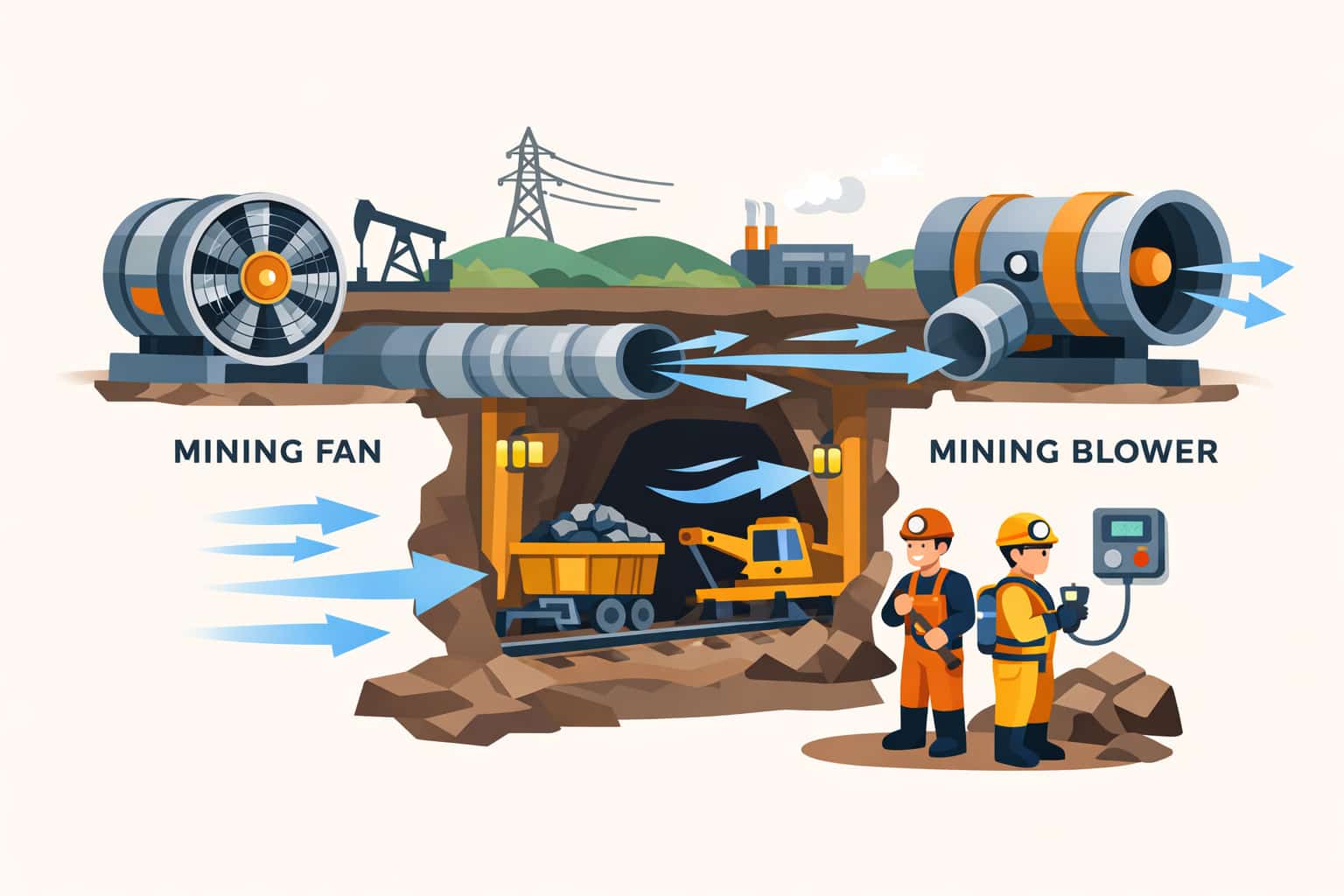
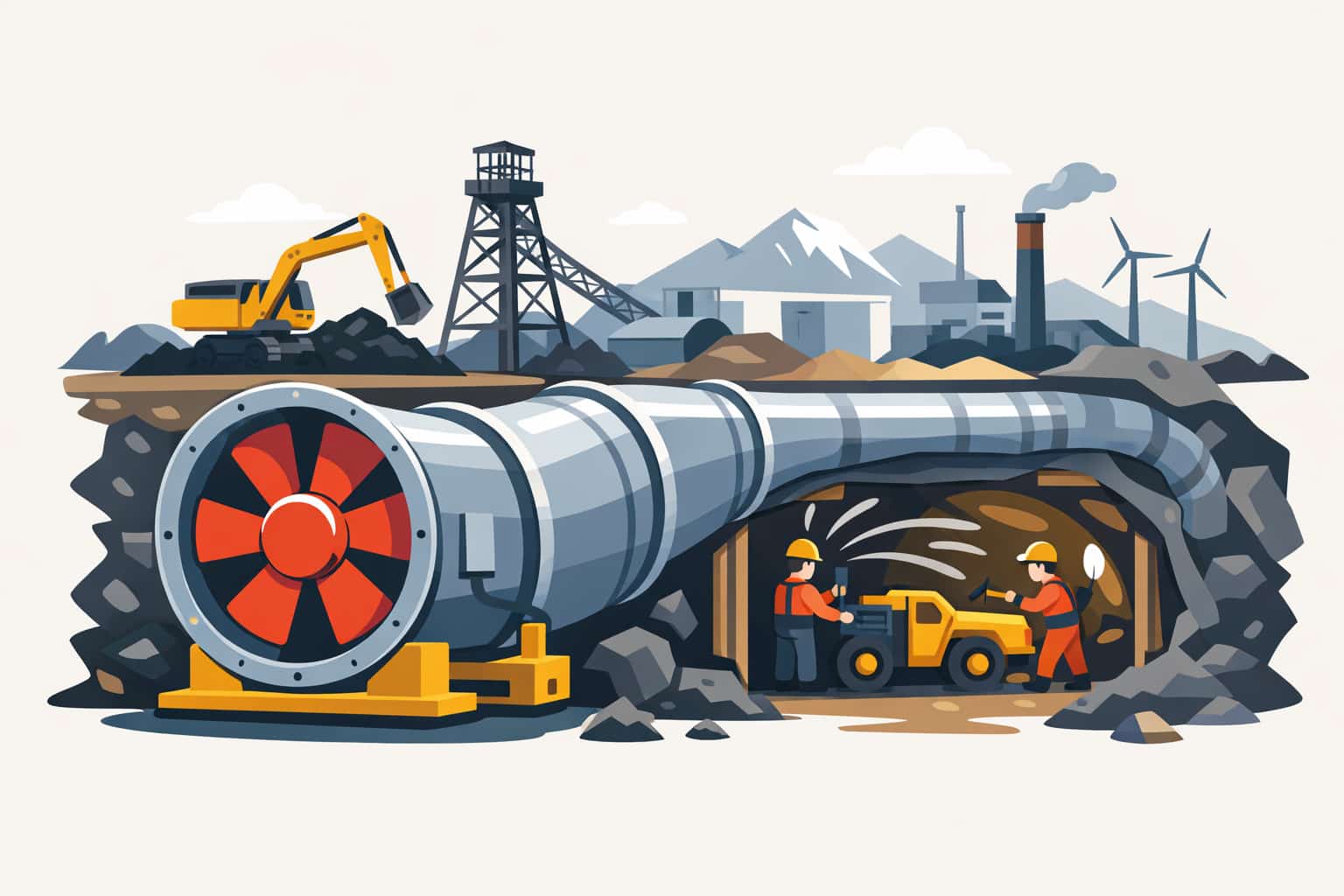



Air density has a direct and significant effect on fan performance. When we talk about fan curves and duty points for industrial or mining ventilation fans, the published data is almost always based on standard air density (typically 1.2 kg/m³ at 20 °C and sea level). If the actual air in your plant or underground mine is lighter or heavier than standard air because of temperature, humidity or altitude, the fan will not behave exactly as it does on the catalogue curve unless you correct for density.
For a given fan running at a fixed speed and moving a given volume flow rate (m³/s or CFM), the basic fan laws tell us that:
- Fan pressure (Pa) is directly proportional to air density. If density drops by 10 %, the developed pressure also drops by about 10 % for the same speed and volume flow.
- Fan power (kW) is also directly proportional to air density (and to flow and pressure). Lower density reduces the power required to move the same volume of air.
- The volume flow delivered by the fan at a given speed depends mainly on fan geometry and system resistance, and is only weakly affected by density, but the mass flow (kg/s) is proportional to density.
This has important consequences for high-altitude or hot mines. At higher elevations, atmospheric pressure is lower, so air density decreases. In deep hot mines, air is also warmer, which further reduces density. A fan selected on the basis of sea-level, cool-air data may not be able to produce the same pressure underground; the actual developed pressure could be significantly lower. To achieve the required pressure and mass flow, you may need a larger fan, a higher speed or multiple fans in series or parallel.
On the other hand, power consumption of the fan at high altitude is lower for the same speed and volume flow, because less dense air requires less power to move. This is why fan motors in high-altitude installations sometimes have lower load margins than expected from sea-level calculations. Engineers often apply a derating factor based on air density to ensure that both performance and motor loading are correct.
In practical fan selection for mining and heavy industry, you should always correct the duty point to site conditions. Start with the required mass flow and pressure at actual temperature, humidity and altitude. Convert these to equivalent standard-air values using density ratios, select the fan using standard curves, then convert the selected fan’s performance back to actual conditions. By doing this, you ensure that the installed fan will deliver the required airflow and pressure in real underground or plant conditions, not just on paper at standard air.