
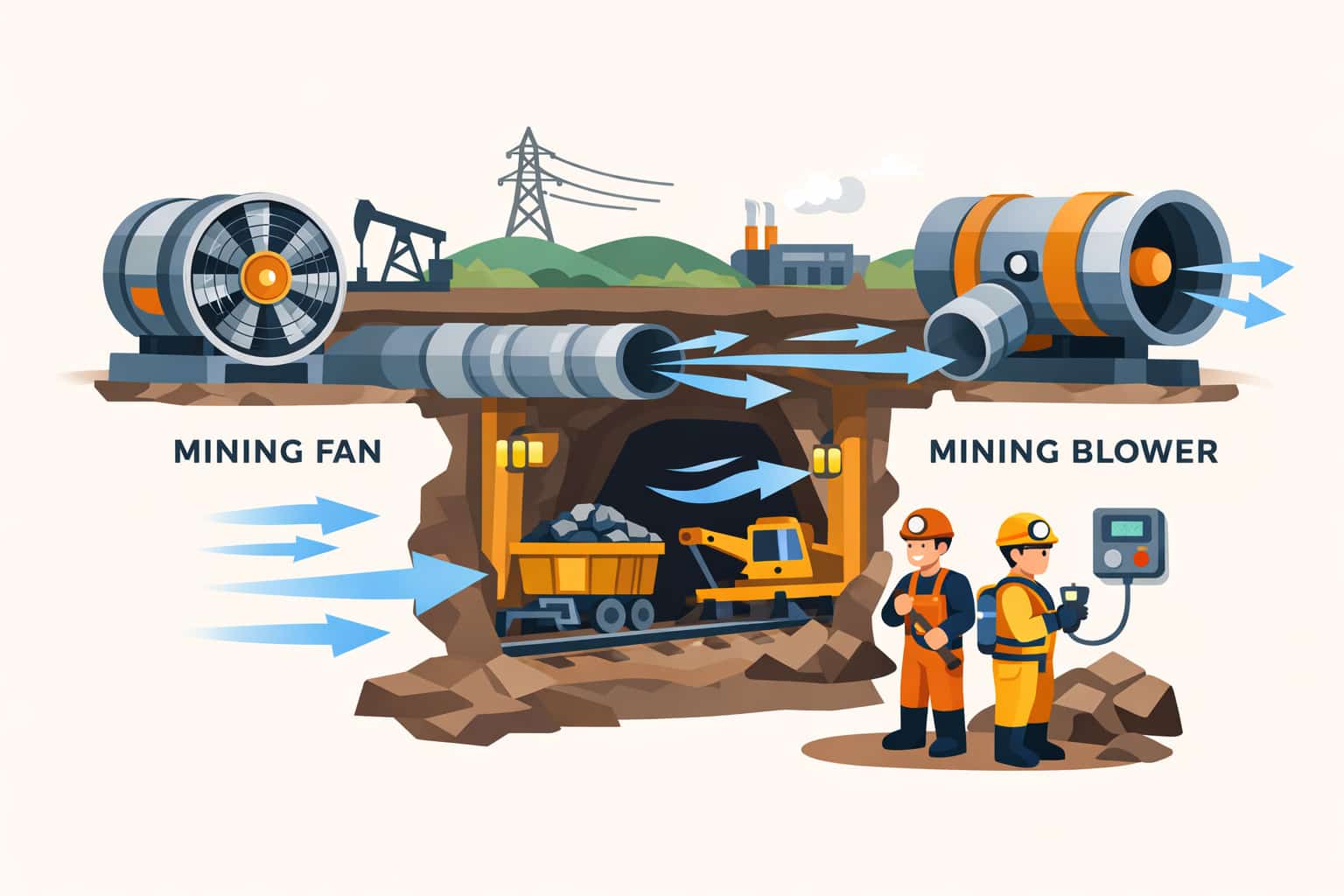




Knowing how to calculate CFM flow is fundamental for selecting and checking fans in industrial and mining ventilation. The most practical method is based on the relationship Q = A × V, which says that volume flow rate equals cross-sectional area times average air velocity. Once you know Q in cubic feet per minute (CFM), you can compare it with fan ratings and design requirements.
To use this method, begin by determining the cross-sectional area of the duct, opening or roadway where the air is flowing. For a circular duct, calculate the area as A = πD²/4, where D is the inside diameter in feet. For a rectangular duct or tunnel, multiply width by height (also in feet), allowing for any obstructions that reduce the clear area, such as cable trays or pipes.
Next, you need to measure the air velocity. Use a suitable instrument such as a Pitot tube, vane anemometer or hot-wire probe, depending on the size and conditions. Take several velocity readings across the cross section following a recognised traverse pattern; velocities are rarely uniform, so a single reading in the centre is not reliable. Average these readings to obtain the mean velocity V in feet per minute (fpm).
Once you have area A (in square feet) and average velocity V (in feet per minute), calculate the CFM using:
Q (CFM) = A (ft²) × V (fpm)
For example, if a duct has an area of 3 ft² and an average velocity of 700 fpm, then Q = 3 × 700 = 2,100 CFM.
If your instruments provide velocity in metres per second and area in square metres, you can first calculate flow in cubic metres per second and then convert to CFM by multiplying by approximately 2,120. In mine ventilation, it is common to work in m³/s, but many fan catalogues and regulations still reference CFM, so accurate conversion is important.
When calculating CFM flow for fan selection, remember that what matters is the flow at the design operating point, not just the maximum possible flow. System resistance, dampers, filters and mine layout all influence the actual CFM the fan will deliver. After calculating or measuring CFM at key locations, you should compare these values with the required air quantities for heat removal, gas dilution and comfort to confirm that the fan and ventilation system are adequate.
In summary, to calculate CFM flow you carefully measure area and velocity, apply Q = A × V, convert units as needed and then interpret the result in the context of your industrial or mining ventilation design.