





To calculate the airflow of a fan, you need both a basic volume flow formula and an understanding of where the fan operates on its performance curve. In industrial plants and mines, airflow is usually expressed as CFM (cubic feet per minute) or m3/h, and correct calculation is essential for safe and efficient ventilation.
The simplest way to calculate airflow is to use the area–velocity method. If you know the average air velocity in a duct and the internal cross sectional area of that duct, you can use:
Q = V × A
where Q is airflow (for example in m3/s), V is average air velocity (m/s) and A is duct area (m2). To convert from m3/s to m3/h you multiply by 3600. To convert to CFM, you multiply m3/s by approximately 2118. In practice, you measure velocity with an anemometer at several points in the duct, calculate an average, and then multiply by the duct area.
For industrial and mining fans, you also use the manufacturer’s fan curve. The curve relates airflow to pressure at a given speed. By estimating or measuring the system pressure at your installation, you can find the point where the system curve intersects the fan curve; the corresponding Q value is the fan airflow at that operating condition. This is more accurate than assuming free delivery, because real systems always have losses.
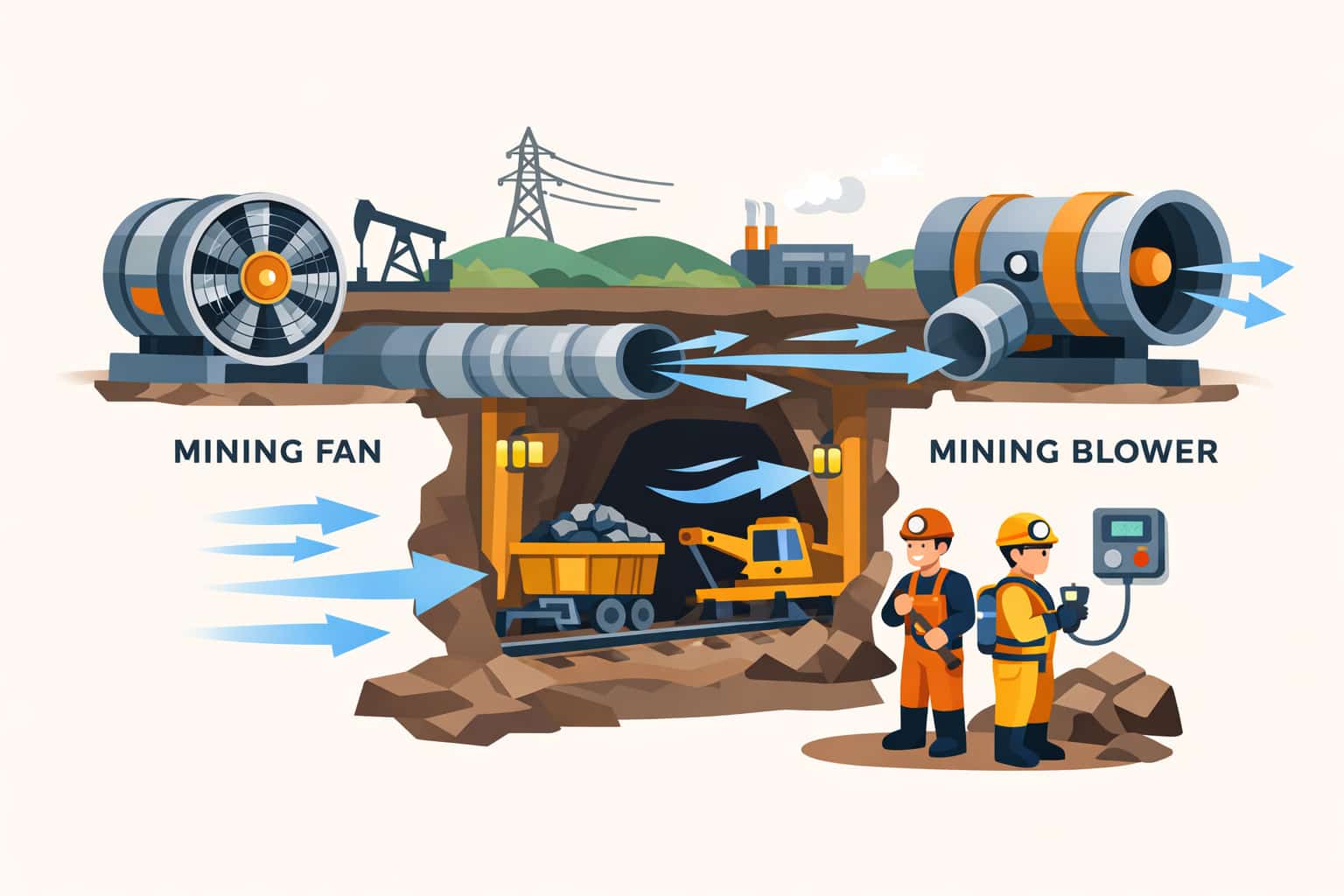
In underground mines, airflow in roadways and headings may be calculated by measuring air velocity across a roadway cross section. The same formula applies: Q = V × A, but the area is the open area of the excavation instead of a duct. These calculations confirm whether main fans and auxiliary fans are delivering the planned ventilation quantity to working faces and return airways.
Another approach is to infer airflow from fan input power and pressure using the fan power equation, but this is less direct and sensitive to efficiency assumptions. Whenever possible, direct velocity measurements combined with geometry and fan curve data give a more reliable result.
In summary, you calculate fan airflow by measuring air velocity and cross sectional area (Q = V × A) and by using fan curves to relate that flow to system pressure. In industrial and mining ventilation, these methods are combined to confirm that fans are moving the correct volume of air for safety and process needs.