












Whether fans should be in series or parallel depends on what you need from your ventilation system. Using multiple fans can be a good way to increase performance, but the arrangement must be chosen and engineered carefully. In simple terms, fans in series are used to increase available pressure, while fans in parallel are used to increase total airflow. In industrial and mining ventilation, both configurations are used, but not interchangeably.
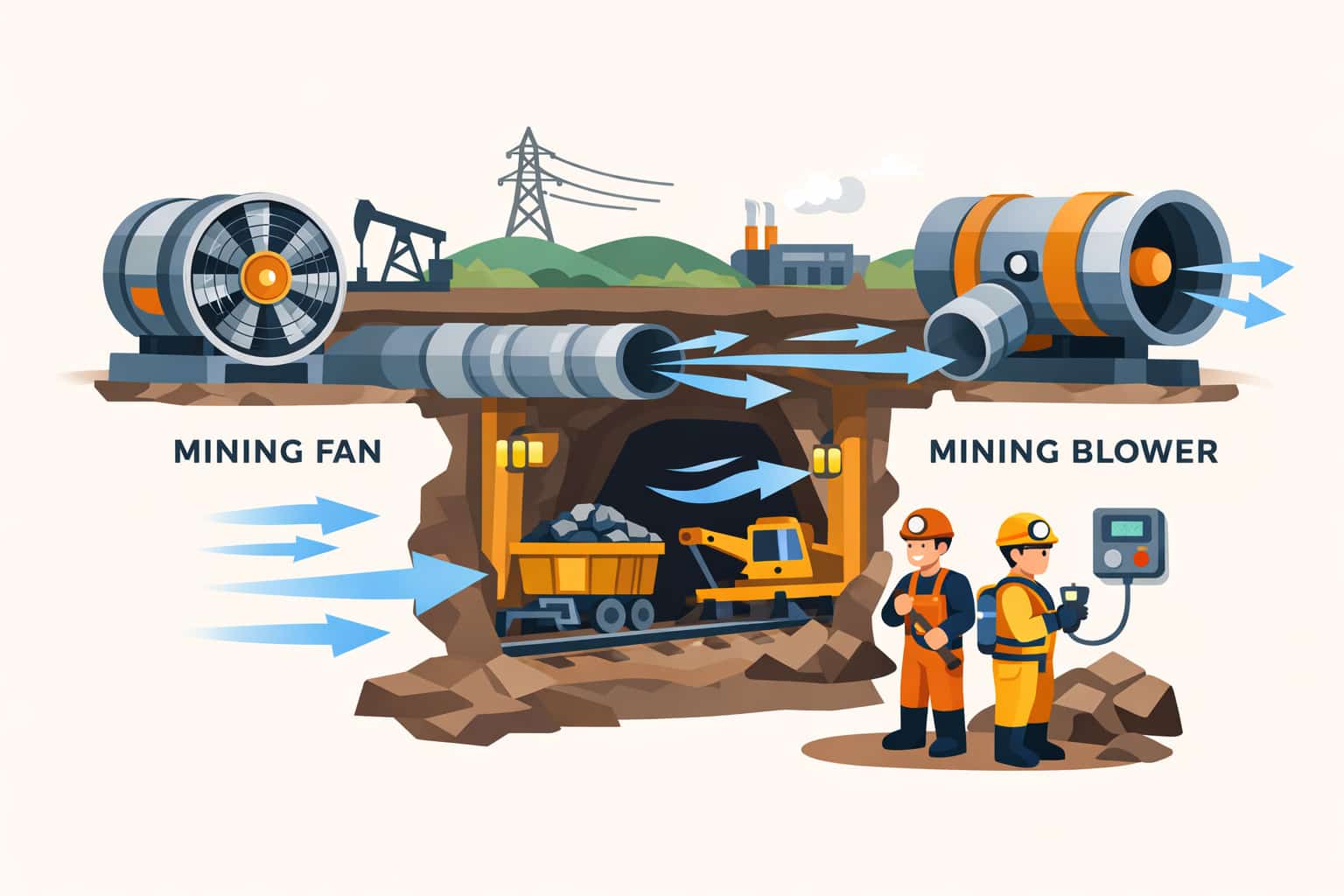
When fans are placed in series, one after another in the same airflow path, the same volume of air passes through each fan. The overall effect is that the pressures add while the airflow is roughly the same as a single fan operating at that point. This arrangement is used when the system has very high resistance, such as long tunnels, shafts, filters or scrubbers, and a single fan cannot provide enough pressure. Series arrangements are also found in booster fan systems in mines, where a booster fan adds pressure to the main airflow along a roadway.
In contrast, fans in parallel are installed side by side, feeding the same duct system or airways. Each fan sees roughly the same pressure, and the airflow contributions add together. Parallel fan arrangements are used when the system pressure is moderate but more total air quantity is needed than one fan can deliver. In mines and large industrial plants, it is common to use multiple identical fans in parallel to share the load, provide redundancy and allow staged operation depending on demand.
From a design perspective, neither series nor parallel arrangements should be chosen casually. Fans must be matched correctly. In series, the fans should have compatible characteristics so that one is not forced into an unstable region by the other. In parallel, using identical or very similar fans and operating them at the same speed avoids uneven load sharing and unstable operation. Controls must also be designed so that fans can start, stop and modulate without causing surges or recirculation.
Another consideration is reliability and maintenance. In a series arrangement, if one fan fails, the entire airflow path is affected because all air must pass through both units. In parallel arrangements, one fan can sometimes be shut down for maintenance while the others continue to run at reduced capacity, providing better redundancy. This is especially important in critical mining ventilation systems where continuous airflow is required for safety.
In summary, fans should be placed in series when you need higher pressure to overcome system resistance, and in parallel when you need higher total airflow and redundancy. The best configuration depends on the specific ventilation requirements, and correct engineering is essential to avoid instability and ensure safe, reliable operation.
