



Airflow efficiency of a fan describes how effectively the fan converts input power into useful airflow. It is a way of expressing how much air you get for the energy you pay for, and it is especially important for large industrial and mining fans that run many hours per year.
One simple measure of airflow efficiency is CFM per watt (or m3/h per kW). This metric compares the fan’s volume flow rate with the electrical power consumed by the motor. A higher CFM/W means the fan moves more air for each unit of energy, indicating better efficiency. For example, a small ventilation fan delivering 1,000 CFM at 100 W has an airflow efficiency of 10 CFM/W.
However, CFM per watt does not account for the pressure against which the fan is operating. Two fans may have the same CFM/W but one might be working against much higher system resistance. For engineering design in industrial plants and mines, it is often more meaningful to look at fan efficiency (air power divided by shaft power) or to use more comprehensive indices such as the Fan Energy Index (FEI), which compare fan performance to reference values across a range of flows and pressures.
Airflow efficiency is influenced by many factors, including:
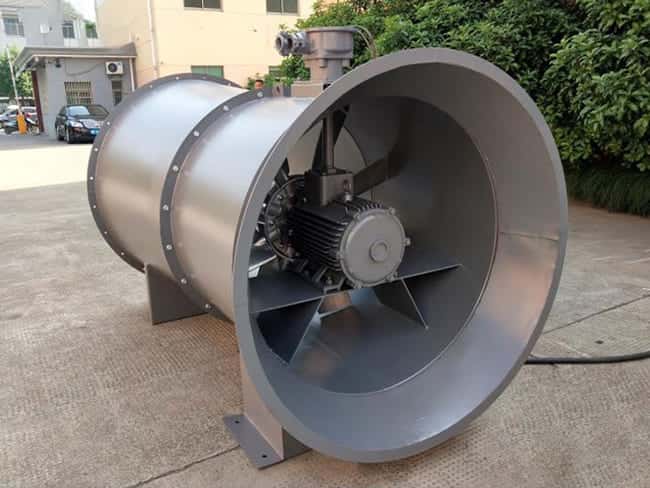
- Aerodynamic design of the blades, inlet bell and outlet diffuser
- Operating point relative to the fan’s best efficiency region on its curve
- System design, such as straight inlets, smooth transitions and low loss fittings
- Motor and drive efficiency (direct coupling vs belts vs gearboxes)
In mining ventilation, where main and auxiliary fans can consume a large share of a mine’s electrical energy, high airflow efficiency means that the required quantities of air can be delivered with less power. This lowers operating costs and can reduce greenhouse gas emissions associated with energy use. Many mines therefore specify minimum fan efficiency or FEI levels when purchasing new equipment.
It is also important to recognise that airflow efficiency is not fixed; it changes with the operating point. A fan might be very efficient at one flow and pressure but significantly less efficient if throttled or operated far from its design duty. Using variable-frequency drives and carefully matching the fan to the ventilation system helps keep operation near the optimal region.
In summary, the airflow efficiency of a fan is a measure of how much useful airflow is obtained per unit of input power, commonly expressed as CFM per watt or through indices like FEI. It depends on fan design, system layout and operating conditions, and it is a key consideration when selecting energy-efficient industrial and mining ventilation fans.