
HP and BHP are related but not identical concepts in fan applications. Understanding the difference between motor horsepower (HP) and fan brake horsepower (BHP) is essential for correct motor selection in industrial and mining ventilation systems.
Brake horsepower (BHP) is the mechanical power required at the fan shaft to move air at a specified flow and pressure. It is calculated from airflow, pressure and fan efficiency, or read directly from the fan’s BHP curve for a given operating point. BHP does not include losses in the motor or drive; it is the power the fan itself demands at its shaft.
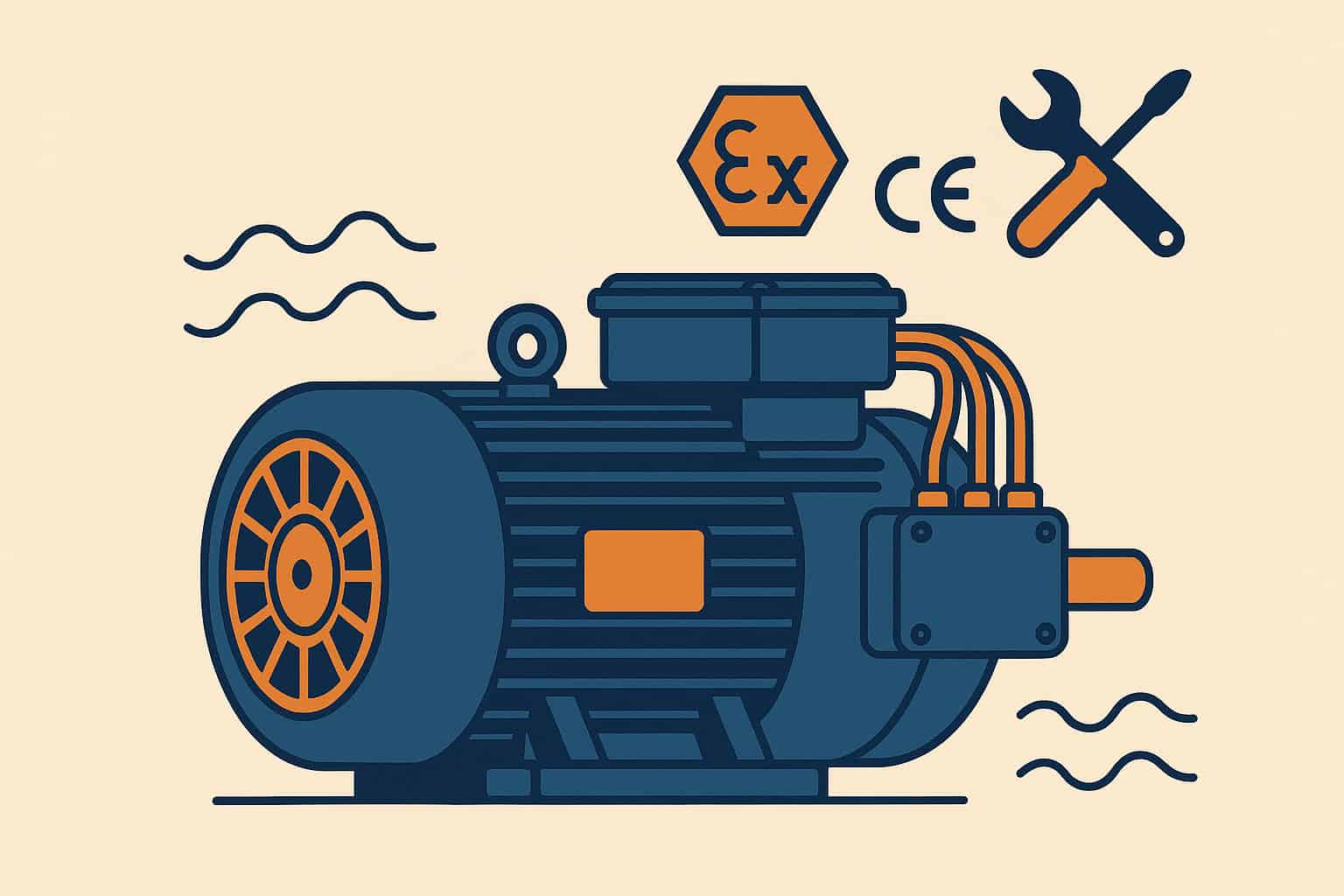
Horsepower (HP) in this context usually refers to the rated output power of the motor. A 15 HP motor is designed to deliver approximately 15 HP of mechanical power at full load at its shaft under standard conditions. However, the electrical input to the motor will be higher due to motor losses, and the delivered shaft power may be slightly different depending on efficiency, voltage, temperature and service factor.
The key practical difference is that BHP is a load requirement, while HP is a motor capability. To avoid overloading the motor, the fan’s required BHP at the design duty must be less than the motor’s rated HP (or the rated HP multiplied by its service factor, if applicable). Engineers typically add a safety margin to account for uncertainties in system resistance, manufacturing tolerances and possible future increases in airflow requirements.
For example, if calculations or fan curves show that a mine ventilation fan needs 18 BHP at the desired duty point, a 20 HP motor may be suitable, but a 15 HP motor would be too small and would likely overload. If the system resistance later decreases (for instance, after duct changes), the fan may move more air and require more BHP, so the margin between BHP and HP becomes even more important.
Another difference is that motor HP rating is fixed, while fan BHP varies with operating conditions. At lower airflow or higher system resistance, the fan may require less BHP than at the design point. If dampers are opened, ducts are shortened or mine airways are improved, the fan may move more air and the BHP can rise, sometimes approaching or exceeding the motor’s HP rating if no margin was allowed.
In summary, BHP is the fan’s shaft power requirement at a specific duty, while HP is the motor’s rated output capability. For reliable industrial and mining fan operation, the motor HP must exceed the fan’s BHP at the worst expected operating condition, with appropriate safety margin and consideration of motor service factor.