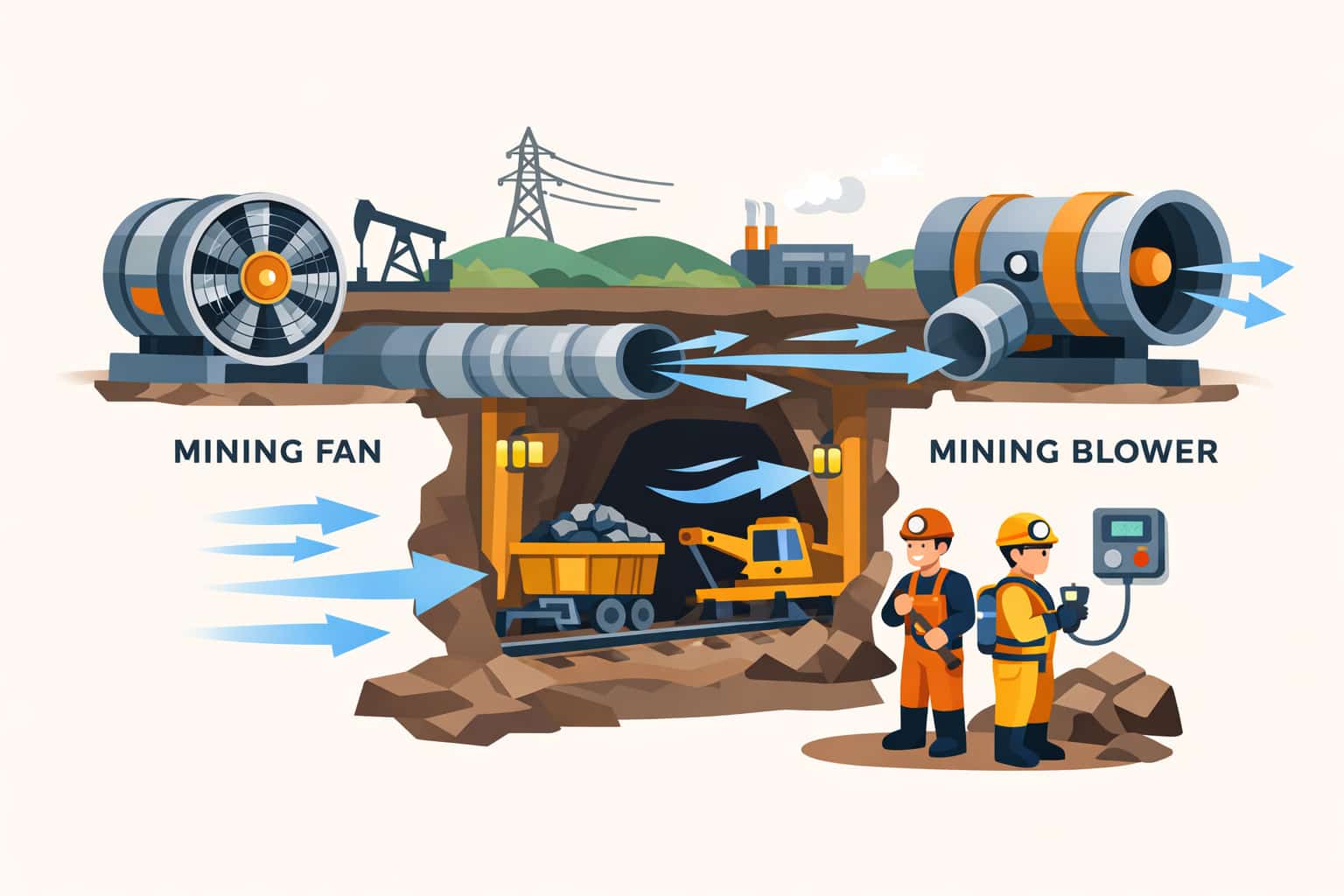
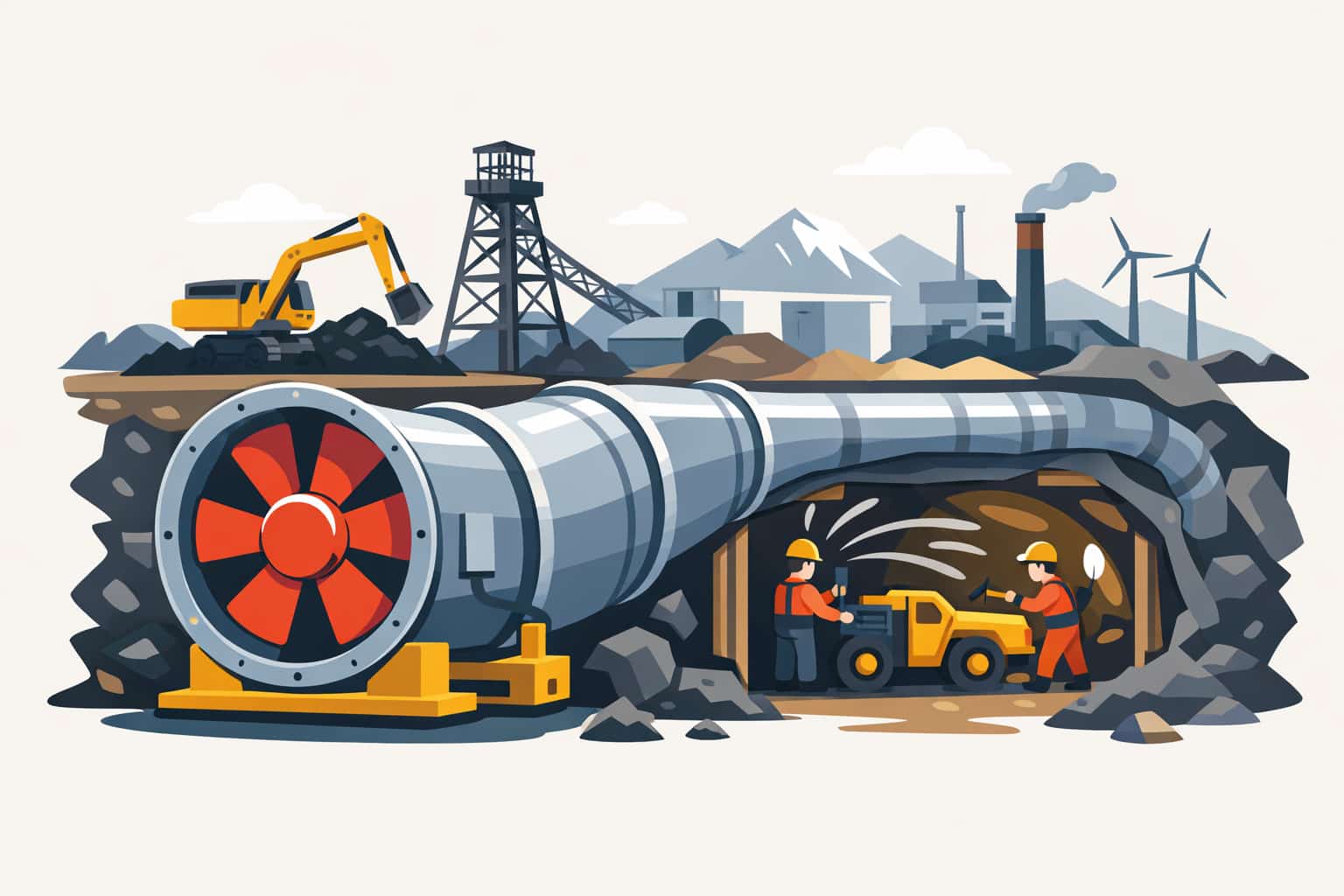

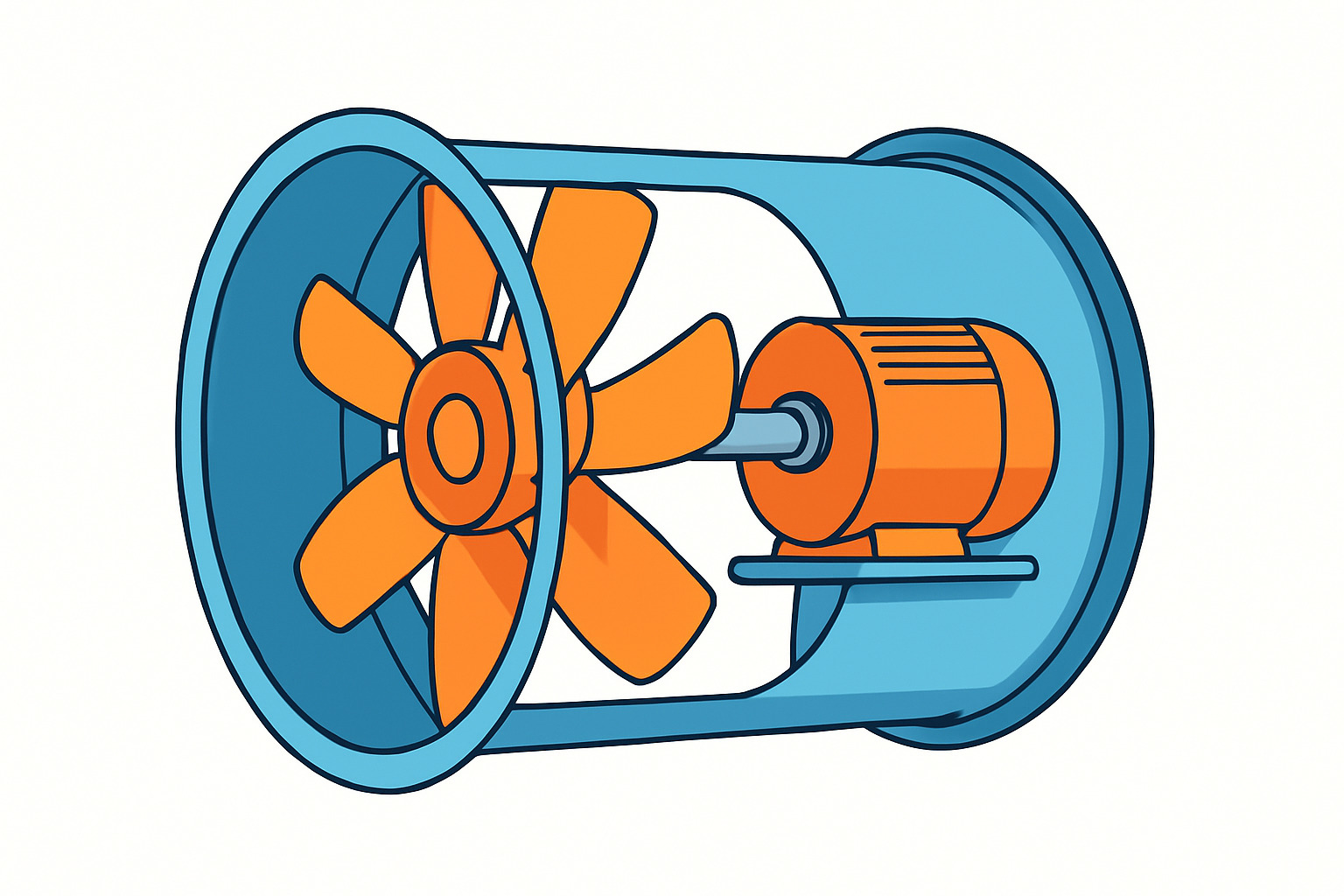

Fan curve theory describes how a fan behaves when it is connected to a real ventilation system. Instead of having a single fixed output, every fan has a whole range of possible combinations of airflow (Q) and pressure (ΔP), plus corresponding power and efficiency values. These relationships are plotted as a fan performance curve. The key idea of fan curve theory is that the actual operating point is found where the fan curve intersects the system curve of ducts, filters, mine airways and other resistances.
The classic fan curve shows airflow on the horizontal axis and pressure on the vertical axis. As airflow increases, the pressure a fan can develop generally decreases smoothly. Additional curves on the same graph show how power input and efficiency change with flow. The shape of these curves is determined by the fan’s geometry (impeller diameter, blade shape, casing) and speed. Manufacturers test fans on standardized rigs to produce accurate curves for engineering use.
Fan laws are part of fan curve theory. They explain how the whole curve shifts when the fan speed or air density changes. For similar conditions and the same fan:
- Airflow is approximately proportional to speed (Q ∝ N).
- Pressure is proportional to the square of speed (ΔP ∝ N²).
- Power is proportional to the cube of speed (P ∝ N³).
This means that even modest speed changes, such as those made with variable-frequency drives, can significantly change fan duty, which is very important in mining and industrial ventilation energy management.
The system curve represents how much pressure is required to push different airflows through the ducts, filters or mine roadways. Because most pressure losses rise roughly with the square of flow, the system curve is an upward-sloping line on the same Q–ΔP graph. Fan curve theory states that the actual operating point will always settle at the intersection between the fan curve and the system curve, where fan-generated pressure equals system resistance.
In practice, engineers use fan curve theory to select and control ventilation fans. By matching the fan curve to the system curve near the fan’s high-efficiency region, they achieve the required air quantity for shafts, drifts, production areas or industrial halls with reasonable energy consumption. When the mine layout changes or ductwork is modified, the system curve shifts, and the operating point moves along the fan curve. Understanding this behaviour is essential for maintaining safe, reliable and efficient mine and industrial ventilation.