





The static pressure of a ventilation fan is the pressure the fan can develop to overcome system resistance at a particular airflow. It is not a single fixed number for the fan; instead, it varies along the fan’s performance curve as airflow changes.
Static pressure is the component of air pressure associated with the potential energy of the air in the ducts or airways, measured relative to atmospheric pressure. It is the pressure required to push air through duct friction, filters, heat exchangers, bends, dampers and, in mines, through long tunnels, raises and regulators. Static pressure is usually measured in Pa (Pascal) or inches of water gauge (in.wg).
When we talk about “the static pressure of a fan”, we really mean the static pressure it can provide at a given flow. Fan manufacturers test their fans and publish static pressure curves, showing pressure on the vertical axis and airflow on the horizontal axis. At low flows, a fan might be able to generate relatively high static pressure; as flow increases, the static pressure typically rises to a peak and then decreases as the fan approaches its maximum capacity.
For example, a ventilation fan might be capable of 600 Pa static pressure at 5 m3/s, 900 Pa at 10 m3/s (its peak), and 500 Pa at 16 m3/s. All of these values are “the static pressure of the fan”, but only one corresponds to the actual operating point, which is determined by the intersection of the fan curve with the system resistance curve.
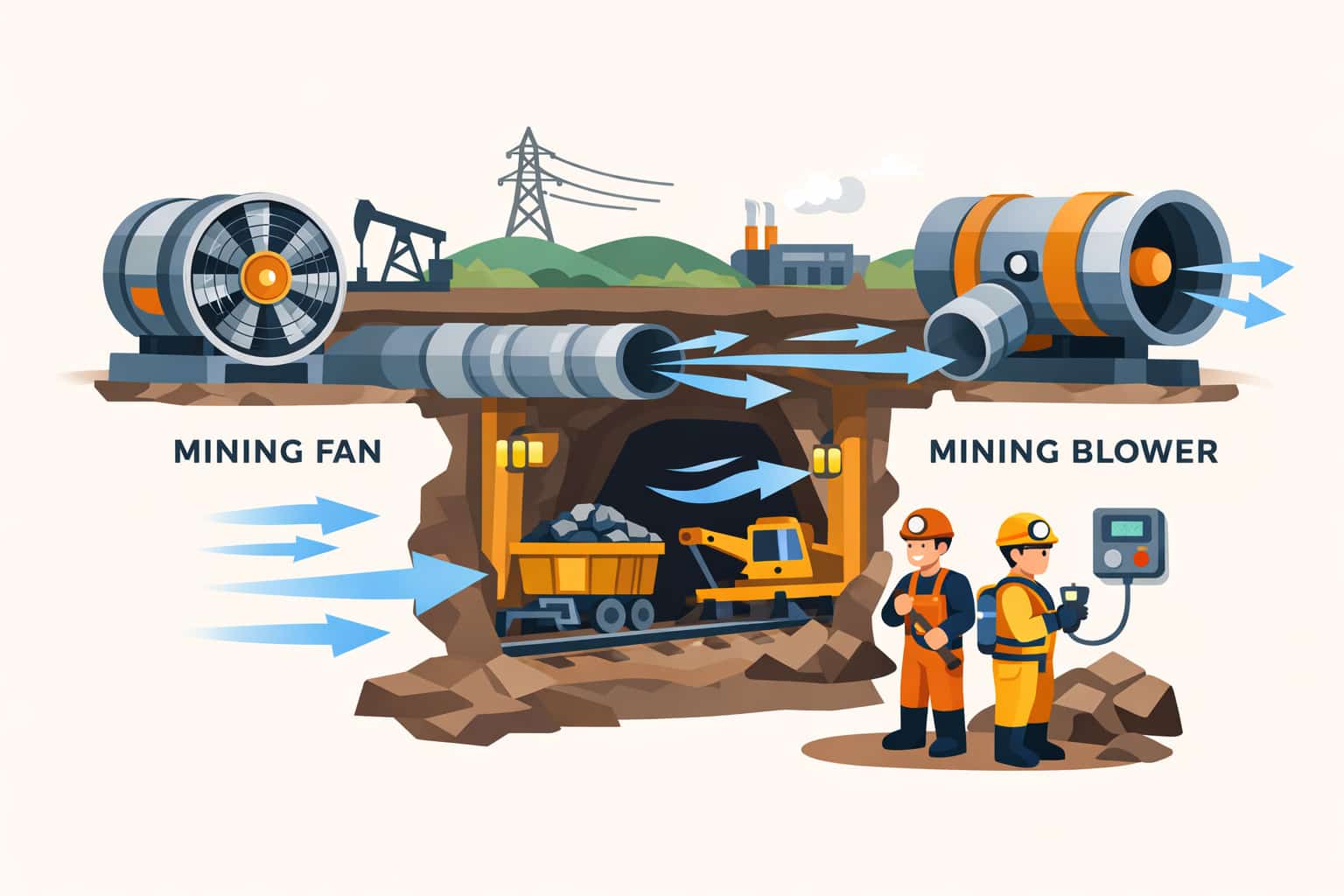
In industrial and mining applications, engineers calculate or measure the static pressure required to move the desired airflow through the system. They then select a fan that can deliver at least that static pressure at the target flow, with a suitable efficiency and safety margin. If the fan cannot deliver enough static pressure, airflow will be lower than intended. If it can deliver far more pressure than needed, the system may be noisy and inefficient.
It is also important to distinguish between static pressure and total pressure. Total pressure is the sum of static pressure and velocity pressure (related to kinetic energy). Fan performance tables may list both total and static pressure. For sizing fans to overcome system resistance, static pressure is usually the focus, while total pressure is used for power calculations and detailed performance analysis.
In summary, the static pressure of a ventilation fan is the pressure it develops to overcome system resistance at a specific airflow, as defined by its static pressure versus flow curve. It is not a single number stamped on the fan, but a variable value that depends on how the fan is applied in the ventilation system.