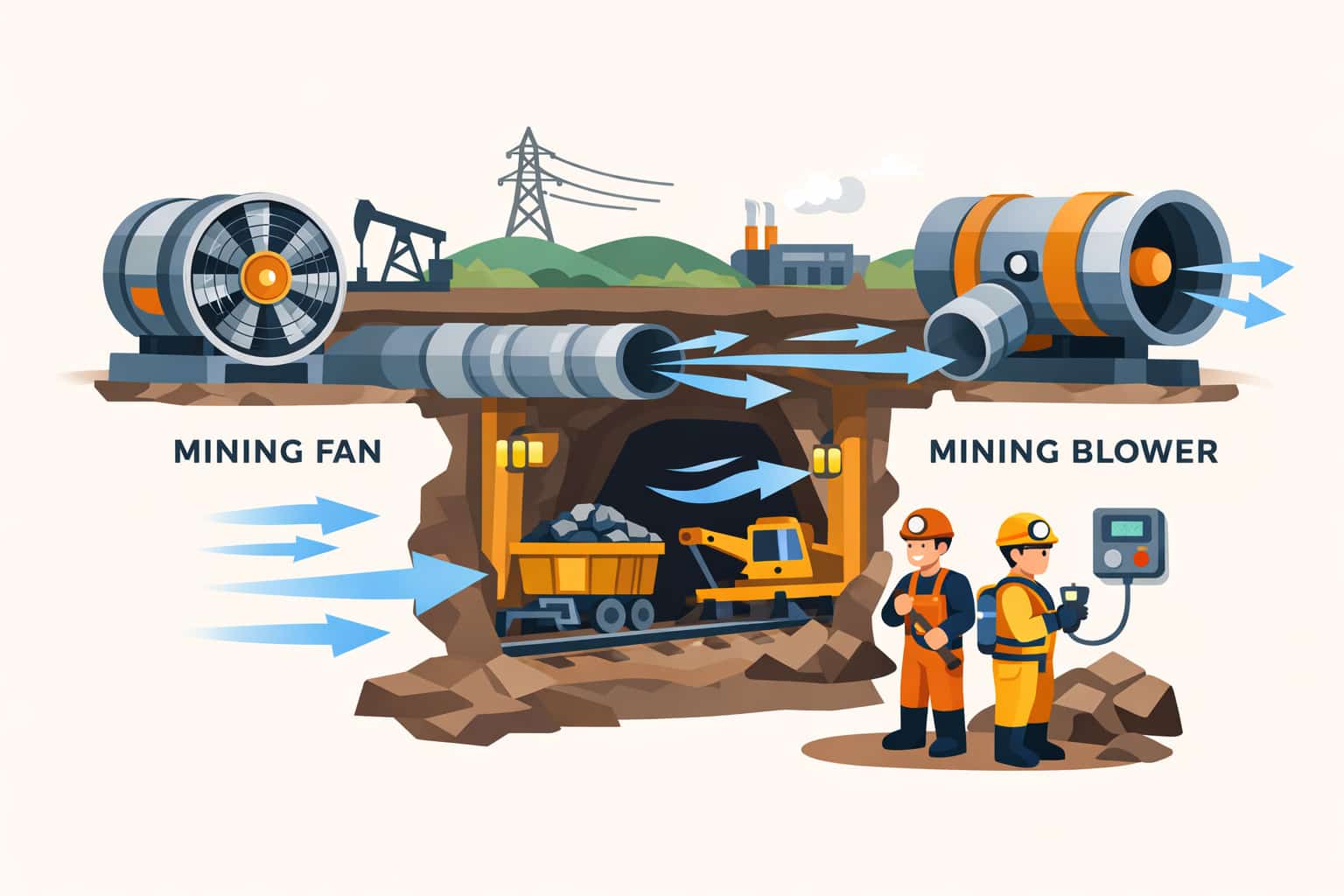
development heading ventilation
Development heading ventilation is the localized ventilation provided to active faces during mine development. Its purpose is straightforward: deliver enough fresh air to dilute gases, control dust, manage heat and humidity, and maintain safe working conditions where the main mine airflow cannot directly serve the face. In most cases, this is achieved with an auxiliary ducted ventilation system—a fan and ducting designed for end-of-duct delivery.
Because headings advance, development ventilation is inherently dynamic. Ducts become longer, additional bends are introduced, and relocation can degrade duct integrity. These changes increase resistance and raise the static pressure (Ps) required to deliver the same face airflow. If selection is based on free-air airflow or nameplate output, the system may fall short as resistance grows. That is why the correct approach is duty-point based: define the required end-of-duct airflow and ensure the fan can meet Q@Ps with usable margin.
Two configurations are common:
- Forcing ventilation: blows fresh air through the duct to the face, commonly chosen for direct delivery.
- Exhausting ventilation: extracts contaminated air from the face, potentially improving contaminant control but often more sensitive to leakage and duct integrity.
Regardless of configuration, performance depends on controlling duct losses and leakage. Good practices include minimizing sharp bends, using appropriate duct diameter and quality, sealing joints, and inspecting duct condition routinely. Ventilation performance should be verified by measurement at or near the duct outlet, not inferred from fan speed or sound.
Control strategy is equally important. A VFD allows speed adjustments as the heading advances and resistance changes, helping maintain target airflow while avoiding inefficient or unstable operation. For development headings, the best “fan vs blower” decision is simply the one that consistently delivers required face airflow under real duct conditions and expected growth.
Contact Us
Contact Us