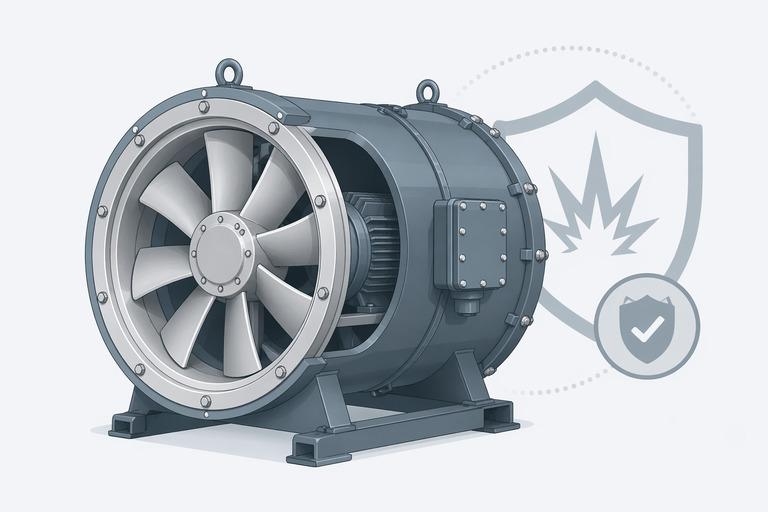
non sparking exhaust fan
A non-sparking exhaust fan is mainly used to extract air from a mine airway, tunnel, fan station, return air system, or hazardous exhaust point. Unlike a general non-sparking fan, its main duty is not only to provide ventilation, but to pull contaminated or used air away from the working area and discharge it safely.
In underground mining and tunnel ventilation, exhaust fans are often connected with return airways, exhaust ducts, or surface fan stations. The air handled by the fan may contain dust, moisture, heat, gas, or other hazardous mixtures. For this reason, the fan structure must be reviewed together with anti-spark design, explosion-proof motor configuration, airflow demand, pressure requirement, and installation layout.
This page focuses on non-sparking exhaust fan applications, including mine return air exhaust, coal mine main exhaust ventilation, tunnel exhaust systems, and explosion-proof axial exhaust fan solutions such as FBCZ and FBCDZ series fans.
Why Exhaust Duty Is Different From Forcing Ventilation
Exhaust ventilation and forcing ventilation are not the same. A forcing fan pushes fresh air toward a working face or local area, while an exhaust fan pulls air out of a tunnel, airway, duct system, or mine ventilation circuit. This difference affects fan pressure, installation position, casing design, air leakage control, and safety configuration.
For a non-sparking exhaust fan, the return air condition is especially important. If the extracted air contains methane, combustible dust, corrosive gas, or high humidity, the fan may require explosion-proof construction, non-sparking impeller protection, corrosion-resistant treatment, or other customized safety features.
| Item | Exhaust Ventilation Fan | Forcing Ventilation Fan |
|---|
| Airflow direction | Pulls air out from a mine, tunnel, duct, or return airway | Pushes fresh air toward a working face or local area |
| Typical location | Surface fan station, return airway, tunnel portal, exhaust duct system | Underground heading, auxiliary duct, local ventilation point |
| Main concern | Return air condition, system resistance, gas or dust risk, safe discharge | Air delivery distance, duct leakage, working face airflow, pressure loss |
| Common fan types | FBCZ exhaust fan, FBCDZ counter-rotating main exhaust fan | FBD, FB, FKD, FK auxiliary forcing fans |
Typical Applications of Non-Sparking Exhaust Fans
Non-sparking exhaust fans are suitable for ventilation systems where used air needs to be removed from the working environment and spark risk must be reduced. In mining projects, they are more commonly related to return air and exhaust ventilation than local fresh-air supply.
Coal mine surface main exhaust ventilation
Mine return air exhaust systems
Underground roadway exhaust ventilation
Tunnel construction exhaust ventilation
Fan station exhaust systems
Hazardous industrial exhaust points
Combustible dust or gas exhaust ventilation
For coal mine projects, exhaust fan selection should be handled carefully because the return air may contain methane, coal dust, moisture, or other hazardous mixtures. For metal mines, non-metal mines, tunnels, and industrial plants, the main selection factors are airflow, pressure, system resistance, air condition, corrosion, temperature, and safety requirements.
Key Design Points for Exhaust-Type Operation
For exhaust-type operation, fan safety and performance depend not only on the impeller material, but also on the whole exhaust system. The fan must maintain stable operation while handling return air, system resistance, vibration, and possible hazardous air conditions.
| Design Point | Why It Matters For Exhaust Fans |
|---|
| Return air handling | The fan may handle air containing dust, moisture, heat, gas, or corrosive elements. |
| Anti-spark structure | Non-sparking impeller areas and protection rings help reduce friction-related spark risk. |
| System resistance | Return airways, ducts, dampers, bends, and fan stations all affect pressure requirement. |
| Explosion-proof motor | Hazardous gas or dust environments may require certified flameproof or explosion-proof motors. |
| Reverse ventilation | Some mine main fans may need reverse airflow capability for emergency ventilation requirements. |
| Noise and vibration | Surface exhaust fan stations often require vibration control, silencing, and stable foundation design. |
FBCZ And FBCDZ Exhaust Fan Selection
For Bofeng mine exhaust fan solutions, FBCZ and FBCDZ series fans are commonly related to coal mine exhaust ventilation and main ventilation systems. The final choice depends on airflow, pressure, mine resistance, installation layout, motor power, and safety requirements.
| Fan Series | Typical Use | Selection Focus |
|---|
| FBCZ Series | Explosion-proof axial exhaust fan for coal mine ventilation and return air applications | Airflow, pressure, motor configuration, exhaust direction, and site safety requirements |
| FBCDZ Series | Explosion-proof counter-rotating axial exhaust fan for mine main ventilation | Higher pressure demand, main fan station layout, reverse ventilation, and mine resistance |
In simple terms, FBCZ is often used where an explosion-proof axial exhaust fan is required, while FBCDZ is more suitable when higher pressure, counter-rotating structure, or main mine exhaust duty is needed. For actual projects, the fan curve and operating point should be checked before confirming the model.
Selection Data Needed For Mine Exhaust Projects
To recommend a suitable non-sparking exhaust fan, the exhaust system data should be collected first. The most important information is not only motor power, but the required airflow, pressure, return air condition, and installation position.
Exhaust application: main exhaust, return air exhaust, tunnel exhaust, duct exhaust, or fan station exhaust
Required airflow and total pressure
Mine resistance or duct resistance
Return air condition, including gas, dust, humidity, corrosion, and temperature
Installation position: surface fan station, underground roadway, tunnel portal, or duct system
Required voltage, frequency, motor power, and starting method
Whether reverse ventilation is required
Required explosion-proof, flameproof, mining safety, CE, or project documents
Common Mistakes When Choosing Exhaust Fans
One common mistake is selecting an exhaust fan only by motor power. Motor power alone cannot determine whether the fan can meet the required airflow and pressure. A 45 kW fan from one structure may perform very differently from another 45 kW fan with a different impeller diameter, blade angle, speed, and pressure range.
Another common mistake is ignoring return air resistance. In real mine ventilation systems, airways, ducts, bends, dampers, leakage, and installation layout can all increase resistance. If the pressure is too low, the actual airflow may be much lower than expected.
For hazardous environments, it is also risky to use a normal industrial exhaust fan without checking explosion-proof and anti-spark requirements. If the air may contain methane, coal dust, or combustible gas, the fan structure, motor protection, and certification should be reviewed before purchase.
Need a Non-Sparking Exhaust Fan for Your Project?
If you need a non-sparking exhaust fan, explosion-proof exhaust fan, coal mine exhaust fan, or return air exhaust fan, please provide your working conditions first. Bofeng can help review the required airflow, pressure, exhaust duty, return air condition, installation layout, and suitable fan series.
For accurate selection, please send the mine type, airflow requirement, pressure requirement, return air condition, voltage, frequency, installation position, and whether reverse ventilation is required. Based on these details, we can provide suitable fan models, technical parameters, performance curves, drawings, and quotation for your project.
Contact Us
Contact Us