
In underground mining and tunneling projects, buyers often ask a simple question: “Can this mine fan send air far enough?” The answer cannot be judged by motor power alone. A 75 kW fan is not always suitable for a longer distance than a 45 kW fan, and a 90 kW fan is not automatically the right choice for every long duct line.
For long-distance mine ventilation, the real selection depends on the required airflow, total pressure, duct diameter, duct length, leakage rate, altitude, air density and site resistance. Motor power is only one result of the fan selection, not the starting point.
This article explains how to judge whether a mine fan can deliver air over a long distance, especially for underground auxiliary ventilation, duct ventilation and development headings.
Manufacturer note: Shandong Bofeng Fan Co., Ltd. designs and supplies mine ventilation fans for underground mining, coal mine ventilation, metal and non-metal mines, tunnel ventilation and long-distance duct ventilation projects. For accurate selection, the fan should be matched to the actual duty point, not selected only by motor power.
Why Motor Power Alone Cannot Decide Long-Distance Ventilation
Motor power tells you how much electrical power the fan motor can provide, but it does not directly tell you how far the air can travel. In mine ventilation, the air must overcome resistance from the duct, bends, leakage, reducers, silencers, dampers and the mine opening itself.
A fan with higher motor power may still perform poorly if the duct is too small, the pressure is not enough, or the fan curve does not match the required operating point. On the other hand, a properly selected lower-power fan may perform better if its airflow and pressure match the actual duct system.
For this reason, professional mine fan selection usually starts with these questions:
How much airflow is required at the working face?
What is the total duct length?
What is the duct diameter?
Is the fan used for forcing ventilation or exhaust ventilation?
What is the expected pressure loss in the system?
Is the mine coal, metal, non-metal or tunnel construction?
Is explosion-proof construction required?
The Key Factors That Decide How Far a Mine Fan Can Send Air
Long-distance ventilation is mainly controlled by airflow and pressure. Airflow decides how much air is delivered. Pressure decides whether the fan can overcome resistance and push or extract air through the duct system.
| Factor | Why It Matters | Common Problem |
|---|---|---|
| Airflow | Determines how much fresh air reaches the working area. | Airflow is too low at the end of the duct. |
| Total pressure | Allows the fan to overcome duct and mine resistance. | Fan cannot push air over a long distance. |
| Duct diameter | Affects resistance and air velocity. | Small ducts create high resistance and pressure loss. |
| Duct length | Longer ducts create more friction loss. | The fan works well near the inlet but poorly at the far end. |
| Duct leakage | Leakage reduces the air volume delivered to the face. | Measured airflow is much lower than expected. |
| Fan curve | Shows whether the fan can operate at the required duty point. | Selected fan is outside the efficient working range. |
Why Duct Diameter Is So Important
For underground auxiliary ventilation, duct diameter has a major impact on long-distance air delivery. If the duct is too small, the air velocity becomes high and friction loss increases sharply. This means the fan needs much higher pressure to deliver the same airflow to the working face.
For example, two fans with similar motor power may perform very differently if one is connected to a larger duct and the other is connected to a smaller duct. The larger duct usually has lower resistance, which allows more air to reach the end of the line.
This is why a mine ventilation fan should never be selected without considering the duct size and duct length. The fan and duct must be treated as one ventilation system.
Forcing Ventilation or Exhaust Ventilation: Which One Sends Air Farther?
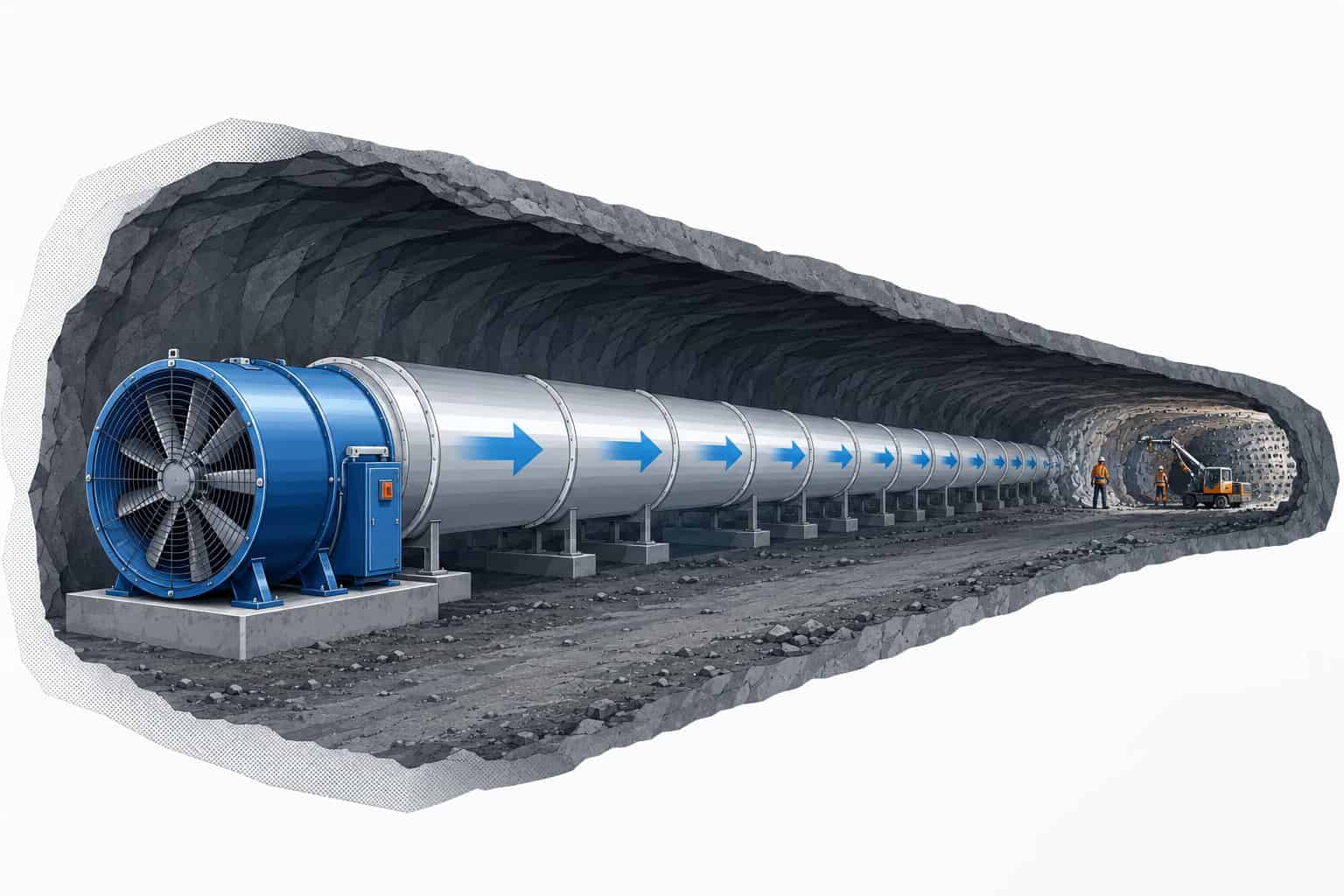
In mine auxiliary ventilation, forcing ventilation is commonly used to deliver fresh air through a duct to a development heading or working face. The fan pushes air into the duct, and the air is discharged near the target area.
Exhaust ventilation removes contaminated air, dust or fumes from a local area by drawing air out through a duct. It can be useful in certain working conditions, but the system resistance and duct leakage must still be calculated carefully.
Important: A forcing fan, exhaust fan or booster fan should not be selected only by name. The required airflow and total pressure must be checked against the fan curve and the actual duct system.
Why a 75 kW Fan May Not Always Be Better Than a 45 kW Fan
Many buyers compare mine fans by motor power first. This is understandable, but it can lead to wrong selection. A 75 kW fan may have higher power, but if its fan curve is not suitable for the required airflow and pressure, it may not deliver the expected result.
The correct comparison should be based on the operating point:
Required airflow at the working face
Required total pressure
Fan efficiency at the duty point
Duct size and duct resistance
Motor speed and impeller design
Noise, vibration and installation conditions
For long-distance ventilation, a high-pressure auxiliary fan or counter-rotating axial fan may be more suitable than a general low-pressure fan with a larger motor. The fan structure and pressure capability matter as much as the motor power.
When Is a Counter-Rotating Mine Fan Needed?
Counter-rotating axial fans are often used when higher pressure is required in underground auxiliary ventilation. They use two impellers rotating in opposite directions to increase pressure capability while maintaining compact axial airflow characteristics.
This type of fan can be useful for long duct lines, higher resistance conditions and development headings where a standard single-stage axial fan cannot provide enough pressure.
However, a counter-rotating fan is not always necessary. If the duct is short, the resistance is low, or the required airflow is moderate, a single-stage axial fan may be more economical and easier to maintain.
What Information Is Needed to Select a Long-Distance Mine Fan?
To judge whether a mine fan can send air over a long distance, the supplier needs more than only the motor power. A practical selection should include the following information:
| Information Needed | Example |
|---|---|
| Mine type | Coal mine, metal mine, non-metal mine or tunnel project |
| Required airflow | m³/s or m³/min |
| Required total pressure | Pa |
| Duct diameter | For example, 560 mm, 800 mm or 1000 mm |
| Duct length | Total distance from fan to working face |
| Ventilation mode | Forcing ventilation, exhaust ventilation or mixed ventilation |
| Power supply | Voltage, frequency and phase |
| Safety requirement | Explosion-proof, flameproof or non-sparking requirements |
Common Mistakes When Selecting Long-Distance Mine Fans
Long-distance ventilation problems often happen because the fan was selected with incomplete information. The most common mistakes include:
Selecting the fan only by motor power.
Ignoring duct diameter and duct length.
Using a low-pressure fan for a high-resistance duct system.
Not considering air leakage from flexible duct joints.
Comparing two fans without checking their fan curves.
Using a general industrial fan where an explosion-proof mine fan is required.
Not confirming whether the fan is for main ventilation or local auxiliary ventilation.
Practical Selection Logic for Long-Distance Mine Ventilation
A practical mine fan selection process should follow this order:
Confirm the required airflow at the working face.
Confirm the duct diameter, length and layout.
Estimate the pressure loss of the duct system.
Select a fan model that can meet the required airflow and pressure.
Check the fan curve and efficiency range.
Confirm motor power, voltage, speed and safety requirements.
Confirm whether accessories such as silencers, control cabinets or flexible connectors are needed.
This process is more reliable than asking only whether a 15 kW, 45 kW, 75 kW or 90 kW fan can send air over a certain distance.
Need Help Selecting a Mine Fan for Long-Distance Ventilation?
If you are not sure whether a mine fan can deliver air over your required distance, please provide the duct diameter, duct length, required airflow, required pressure, mine type and power supply. Our technical team can help match the fan model, motor power and ventilation arrangement according to the actual site conditions.
For product options, you can review our mine auxiliary fans and mine axial flow fans.
FAQ About Long-Distance Mine Fan Selection
Can a higher kW mine fan always send air farther?
No. Higher motor power does not automatically mean longer air delivery distance. The fan must provide the required airflow and pressure for the actual duct system. Duct diameter, duct length, leakage and resistance are all important.
What type of fan is usually used for long-distance underground duct ventilation?
For underground development headings and duct ventilation, auxiliary axial fans or counter-rotating axial fans are commonly used. The final choice depends on airflow, pressure, duct length and whether the mine requires explosion-proof equipment.
Why does duct diameter affect long-distance ventilation?
A smaller duct usually creates higher resistance and pressure loss. If the duct is too small, the fan may not deliver enough air to the end of the line, even if the motor power is high.
Is forcing ventilation better than exhaust ventilation for long-distance air supply?
Forcing ventilation is commonly used to deliver fresh air to underground working faces through ducts. Exhaust ventilation may be used for removing fumes, dust or contaminated air. The best method depends on the mine layout and ventilation design.
What should I provide before asking for a mine fan quotation?
You should provide the required airflow, total pressure if available, duct diameter, duct length, mine type, installation location, power supply and explosion-proof requirements. This allows the supplier to select the fan by actual duty conditions instead of guessing by motor power.