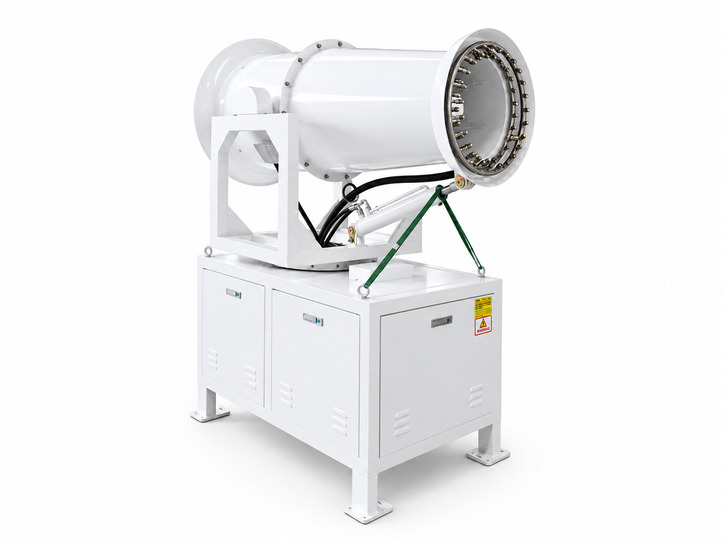
The Mining Dust Suppression Fog Cannon is designed for controlling fugitive dust in open and semi-open mining areas. Pressurized water is atomized through the nozzle system, while fan-assisted airflow carries the fine water droplets toward the dust source or drifting dust cloud. When the droplets contact suspended dust particles, they promote wetting, collision and agglomeration, helping the heavier dust-and-water particles settle before spreading farther across the working area.
The equipment is suitable for open-pit mines, coal stockpiles, ore and waste-rock yards, crushing and screening plants, truck loading and unloading areas, open conveyor transfer points, temporary material-handling areas and local mine-road dust hotspots. It is especially suitable for controlling coal dust generated during coal stacking, reclaiming, loading, unloading and wind erosion from dry coal pile surfaces.
According to the site layout and operating requirements, the fog cannon can be supplied in a fixed or mobile configuration. Fixed units are suitable for permanent dust-control points, while mobile units can be repositioned as the active mining, loading, unloading or stockpile working area changes.
1. Initial Selection Parameters
Initial model selection is primarily based on the required coverage area, spray distance and site voltage. These three parameters help determine the basic size and configuration of a single mining fog cannon.
Selection Information | Details to Provide |
Required Coverage Area | Provide the approximate area that one fog cannon needs to cover, measured in square metres (m²). Coverage area is affected by spray distance, rotation range, installation height, wind direction and the layout of the working area. |
Required Spray Distance | Provide the distance from the proposed equipment position to the farthest dust-control point, measured in metres (m). The required distance should be based on the actual installation position and dust source. |
Supply Voltage | Provide the available site voltage, frequency and number of phases, such as 380 V/50 Hz, 440 V/60 Hz or another required power supply. |
2. Fixed or Mobile Configuration
Fixed Fog Cannon: Suitable for permanent dust-control locations such as receiving hoppers, fixed crushing plants, loading stations, conveyor transfer areas and stockyard boundaries.
Mobile Fog Cannon: Suitable for coal stockyards, temporary loading and unloading areas, changing crushing locations and other mining operations where the active dust source frequently moves.
For coal stockpile applications, a mobile fog cannon can be moved closer to the active stacking, reclaiming, loading or unloading point. This allows the equipment to follow loaders, excavators, trucks, stackers or reclaimers as the working position changes.
For large permanent coal yards, fixed spraying can provide routine background coverage, while a mobile fog cannon can provide supplementary dust control around changing high-dust working areas.
3. Additional Configuration Information
After the initial model has been selected according to the coverage area, spray distance and voltage, the following information should also be confirmed before the final configuration and quotation are prepared.
Configuration Item | Information to Confirm |
Installation Type | Confirm whether a fixed or mobile fog cannon is required. If the configuration has not yet been determined, provide the site layout and operating method for selection support. |
Water Supply | Provide the available water pressure, water flow and water quality. Water filtration requirements should be confirmed according to the selected nozzle and water system. |
Installation Position | Specify the proposed equipment location, distance from the dust source, installation height, surrounding obstacles and available operating space. |
Rotation and Elevation | Provide the required horizontal rotation range and vertical elevation range according to the dust-control area and proposed installation position. |
Control Method | Confirm whether local control, remote control or another control arrangement is required. |
Site Conditions | Provide the local wind direction, typical wind conditions, ambient temperature, drainage conditions and any special environmental requirements. |
Material Conditions | Identify the material or dust source and confirm whether the material can accept additional moisture from the spray. |
4. Selection Notes
Effective spray distance and coverage may vary according to installation height, wind direction, surrounding obstacles, spray angle and actual operating conditions.
Published maximum spray distance should not be treated as guaranteed effective coverage under every wind and site condition.
The fog cannon is mainly intended for open and semi-open fugitive dust control. It does not draw dust-laden air through a duct for internal treatment.
For enclosed crushers, fixed conveyor transfer points, fine screening equipment and other concentrated dust sources, the fog cannon should normally be used together with source enclosure, local water sprays or dust extraction equipment.
Please provide the required coverage area, spray distance and site voltage for initial model selection. Site photographs or a layout showing the proposed installation position and dust source can help determine whether a fixed or mobile fog cannon configuration is more suitable.