Mine ventilation fan is a large industrial fan used to move fresh air through an underground mine or tunnel. Its main job is to supply enough clean air, dilute and carry away dust and harmful gases, control temperature and humidity, and maintain a safe working environment for miners.
Without properly designed and controlled ventilation fans, underground mines can quickly accumulate methane, diesel fumes, blasting gases and respirable dust, creating serious risks of explosions, poisoning and long-term lung disease.
Why Ventilation Fans Are Essential in Mining
Modern underground mines rely on a complete ventilation system that includes:
Main airways and return airways
Shafts and raises
Stoppings, doors, regulators and ducting
Plus one or more large mine fans to drive the airflow
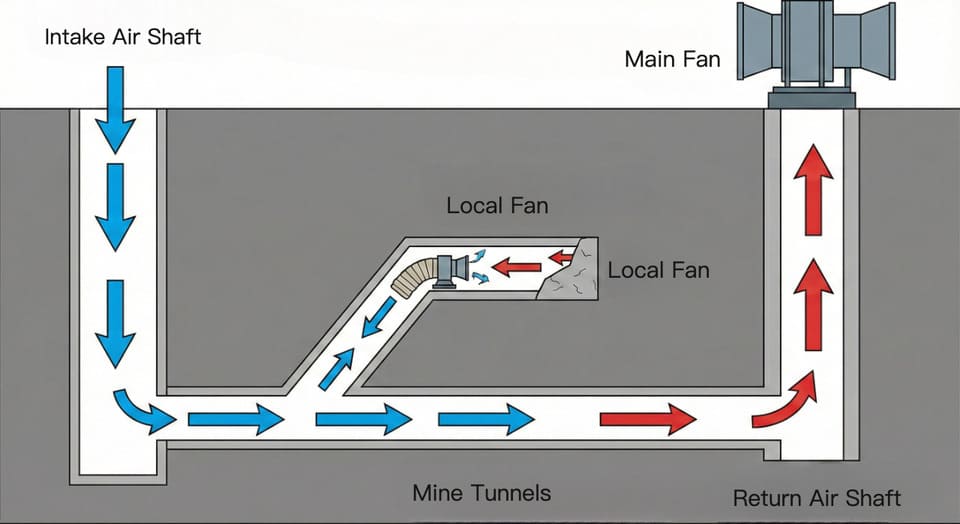
Figure: Simplified underground mine ventilation system with intake shaft, main fan on surface, local fans at the headings, and airflow returning through the return air shaft.
Mine ventilation fan are the “engine” of this system. They:
Push or pull fresh air from surface into the mine
Dilute methane, CO, NOx, SO₂ and other gases to safe levels
Control dust concentration at the face and loading points
Remove heat and humidity generated by rock, equipment and deep mining
Maintain air velocity so that contaminants do not “hang” in dead zones
A well-designed fan system is therefore one of the most important parts of mine safety management.
What Are the Main Types of Mine Ventilation Fans?
In mine ventilation engineering, fans are usually grouped by duty and location rather than by brand.That’s why the common question—what kind of fan is used in mines—is best answered by looking at where the fan works in the ventilation network.
1. Main (Primary) Fans

Figure: Surface main mine ventilation fan station providing airflow for the underground and pit workings.
Main fans (or primary fans) are large, high-capacity fans installed on the surface, usually near the main shaft or drift. They generate most of the pressure and airflow for the entire mine ventilation circuit.
Typical features:
Installed on surface in a fan house or concrete structure
Often in duty + standby configuration for reliability
Equipped with silencers, diffusers and inlet cones to improve efficiency
Driven by high-power motors, often with variable-speed drives
2. Booster Fans
Booster fans are large fans installed underground in series with the main fan. They are used in deep or high-resistance mines to increase pressure in part of the ventilation network and help push air to remote districts.
Because booster fans change pressure distribution, their design and control must follow strict safety rules to avoid unexpected flow reversals or dangerous gas accumulation.
3. Auxiliary and Local Fans

Figure: Auxiliary mining fan with flexible ducting supplying fresh air directly to the development heading.
Auxiliary fans and local ventilation fans are smaller fans used to ventilate development headings, production faces and blind headings that are not directly in the main airflow.
They usually:
Stand near the entrance of a heading or in-bye roadway
Connect to ventilation ducting (rigid or flexible)
Supply fresh air directly to the working face and dilute dust and fumes from drilling, blasting and loading
In coal mines, you will also see explosion-proof local fans combined with long distance ducting for face ventilation.
Axial vs. Centrifugal Mine ventilation fan
From an aerodynamic point of view, most mine ventilation fans belong to two families.
Axial-Flow Mining ventilation Fans
Air enters and leaves parallel to the fan shaft
High air volume at relatively low to medium pressure
Compact design, typically with cylindrical casing and adjustable blades
Very common as main, booster and auxiliary fans in metal and coal mines
Axial fans are well suited for:
Long airways with moderate resistance
Situations where efficiency and variable-pitch control are important
Reversible ventilation (for some designs), useful for emergency smoke control
Centrifugal Mining ventilation Fans
Air enters near the center of the impeller and leaves radially, turning 90° inside the casing
Deliver lower air quantity but higher pressure than axial fans
Often used where the mine has very high resistance or where robust construction is required
Centrifugal fans can be a good choice for:
Deep mines with high static pressure
Shafts and drifts with large pressure drops
Applications requiring rugged equipment and heavy-duty casings
In practice, the choice between axial and centrifugal mining fans depends on:
Required airflow (m³/s or CFM)
Total pressure (Pa or kPa)
System resistance curve (including Atkinson resistance)
Noise limits, efficiency targets and available installation space
Key Technical Parameters of a Mining Fan
When engineers design or select a mining fan, they focus on several core parameters:
Airflow (Q)
Volume of air delivered, usually in m³/s or m³/h (or CFM in some countries).Total pressure / Static pressure (Pt, Ps)
Pressure rise created by the fan to overcome the resistance of shafts, roadways, ducting and stopping leakage. Often expressed in Pa or kPa.Efficiency (η)
Ratio of air power to shaft power. Higher efficiency reduces energy costs over the life of the mine.

Figure: Performance map of an axial mining fan showing static pressure vs airflow, efficiency contours and blade pitch angle lines.
Fan curve
Relationship between airflow and pressure for a given fan speed. Intersection with the system resistance curve gives the operating point.Power & speed
Motor power (kW or HP) and fan speed (rpm) must match ventilation duty, energy cost and starting method (direct-online, soft-starter, VFD).Noise and vibration
Important for both worker comfort and structural safety; often controlled with silencers, flexible joints and isolation bases.
Safety and Explosion Protection
Because mining fans directly influence underground atmosphere, they are covered by strict safety standards and guidelines.
Key aspects include:
Explosion protection
In gassy coal mines and some metal mines, main and auxiliary fans may need explosion-proof designs and Ex-rated motors to avoid ignition sources in potentially explosive atmospheres.Reliability and redundancy
Duty/standby arrangements, automatic change-over and emergency power supply help ensure that airflow is maintained even if one fan or power line fails.Monitoring and control
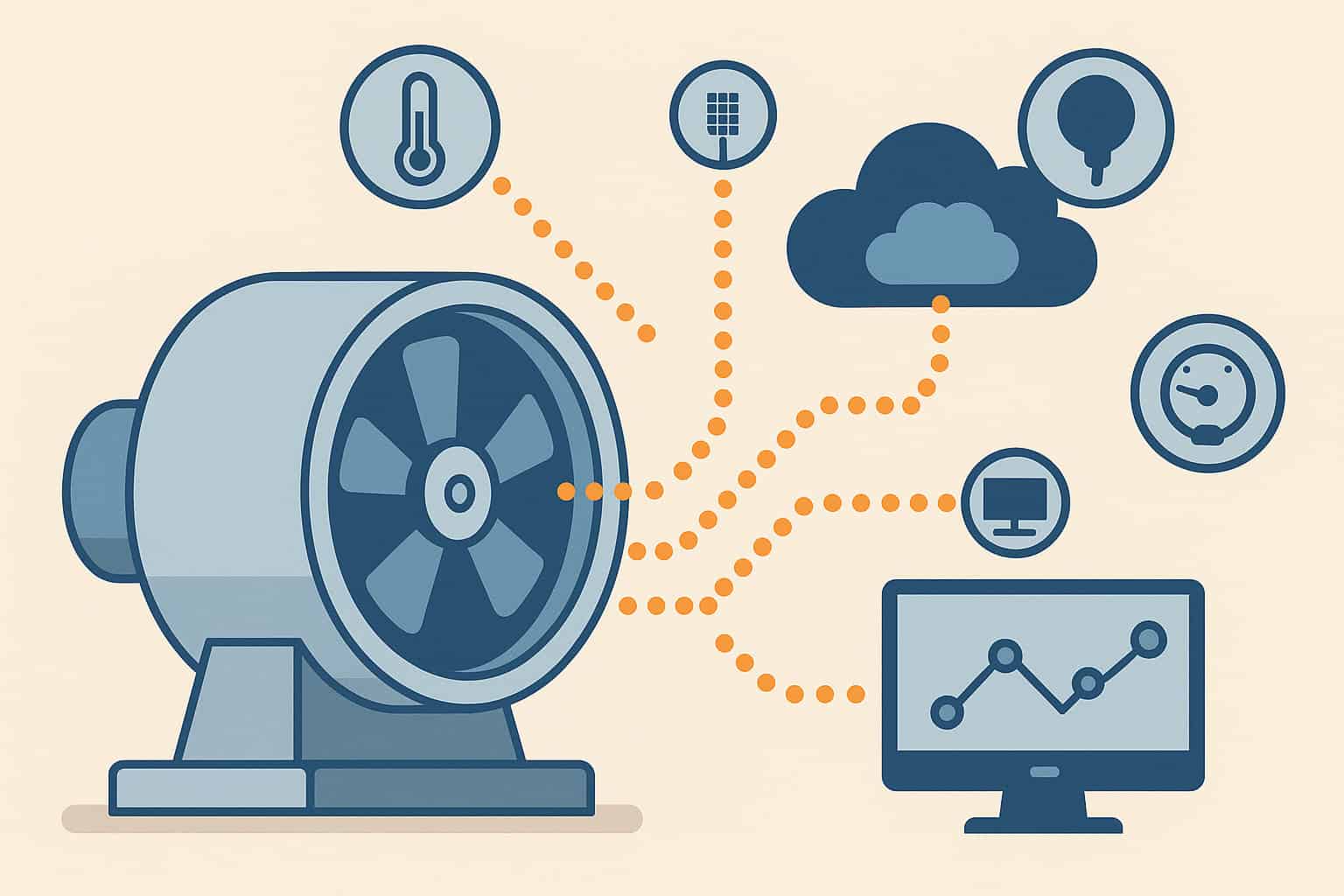
Modern mines use sensors and control systems to continuously monitor:Fan speed, current and vibration
Differential pressure across the fan
Airflow, gas concentration and temperature in main airways and returns
Procedures for starting and stopping
Changing fan operation can significantly alter airflow distribution; regulations typically require risk assessments and operating procedures for planned fan outages.
Typical Applications of Mine ventilation fan
Mine ventilation fans are used in almost every type of underground operation:
Coal mines – main and booster fans for whole-mine ventilation; explosion-proof local fans for long faces and development headings.
Metal and non-metal mines – large axial main fans for ramp and shaft systems, plus auxiliary fans for declines and production stopes.
Tunnels and civil works – axial fans and ducting for road, rail and hydro tunnels, often similar to mining auxiliary ventilation.
Dust and fume control – combined use of ventilation and water/dust collectors to reduce respirable dust and diesel particulate.
Proper fan selection and positioning can significantly reduce energy consumption while still delivering the required air quality underground.
Need Ventilation Fans for Mines or Tunnels?
Browse our axial & centrifugal series for underground ventilation applications.
How to Choose a Mine ventilation fan (Engineer’s View)
A professional selection process usually includes:
Define ventilation demand
Required air quantity for each district and total mine
Regulatory minimums (per person, per diesel equipment, per heading)
Build or update the ventilation network model
Roadway lengths, cross-sections and Atkinson resistance
Stoppings, regulators, doors, leakage paths
Select fan type and configuration
Axial vs centrifugal
Single fan, twin fans in parallel or series
Duty/standby arrangement, possible booster fans
Check operating points and fan curves
Ensure stable operation close to peak efficiency
Confirm there is margin for future production expansion
Verify safety, noise and standards compliance
Explosion-proof requirements (where applicable)
Local ventilation regulations and guidelines
Plan monitoring and control
Use of VFDs to trim flow and save energy
Integration with mine SCADA or ventilation control systems
References / Further Reading
Textbooks & Handbooks
McPherson, M.J. – Subsurface Ventilation Engineering (online textbook, PDF)– Online textbook on subsurface ventilation engineering, including mine ventilation networks and main/auxiliary fans.
Kissell, F.N. – Handbook for Dust Control in Mining (NIOSH IC 9465)– Fundamental handbook explaining dust generation and control in mining, with extensive use of mine ventilation principles.
Cecala, A.B. et al. – Dust Control Handbook for Industrial Minerals Mining and Processing, 2nd ed. (NIOSH)– Detailed handbook on engineering controls and ventilation-based dust control for industrial minerals mining and processing operations.
Government & Regulatory Guidelines
NSW Resources Regulator – Underground coal mines: guidance on ventilation and mine fans– Official guidance material on ventilation systems and the role of main, booster and auxiliary fans in underground coal mines.
Technical Reference Guide: Main Fans, Booster Fans and Auxiliary Fans in Underground Coal Mines– Regulatory technical reference covering design, operation and risk management for mine ventilation fans.
Research Papers & Journal Articles
Bhattacharya, S. et al. – Reverse Performance Characteristics of Main Mine Fans (U.S. Bureau of Mines)– Study of airflow and pressure behaviour when reversing main mine fans, relevant for emergency ventilation and fan design.
Saleem, H.A. et al. – Energy Consumption Reduction in Underground Mine Ventilation Systems (Sustainability, 2025)– International journal article presenting methods to optimise fan operation and reduce power consumption in mine ventilation.
Guo, B. et al. – Optimization of Mine Ventilation Energy Consumption Based on an Enhanced Dung Beetle Optimizer (Scientific Reports, 2025)– Research on intelligent optimisation of mine ventilation networks and fan settings to improve efficiency and reduce energy use.
Yu, B. et al. – An Optimization Method of Mine Ventilation System Based on Multi-Objective Programming (Energy Reports, 2022)– Describes a multi-objective optimisation model for mine ventilation system design, including fan shaft power and energy consumption.
Niubó, M. et al. – Assessing Mine Ventilation Optimization and Friction Factor Determination (Arabian Journal of Geosciences, 2025)– Review of methods for estimating friction factors and optimising underground mine ventilation networks.
A Review on Underground Mine Ventilation System (Journal of Mines, Metals and Fuels)– Literature review summarising previous studies on mine ventilation system design and optimisation methods.
General Background
Underground mine ventilation – Wikipedia– General overview of underground mine ventilation, airflow patterns, contaminants and regulatory requirements.
Mine safety – ventilation section – Wikipedia– Summary of the role of ventilation as a key element of mine safety management.