
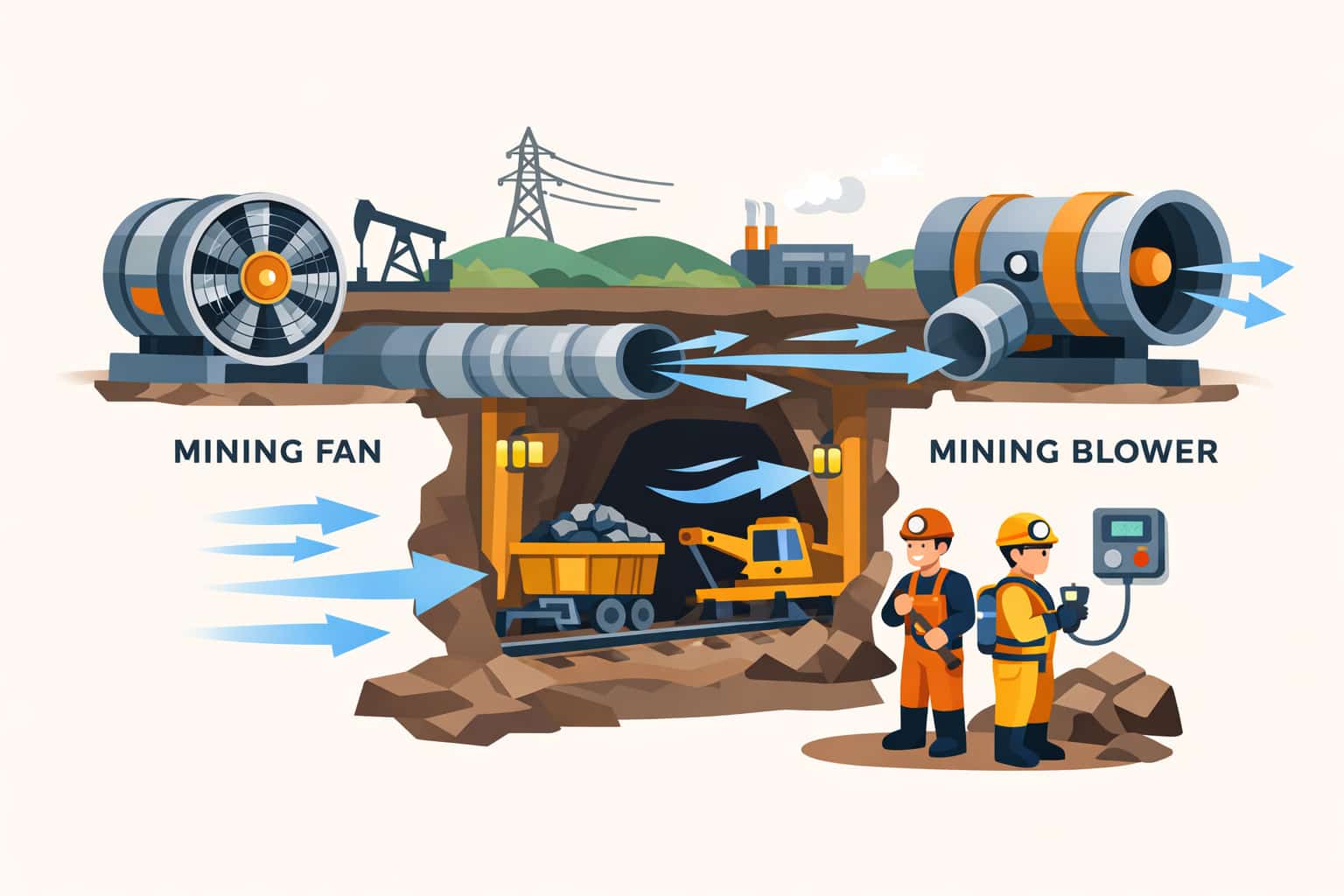
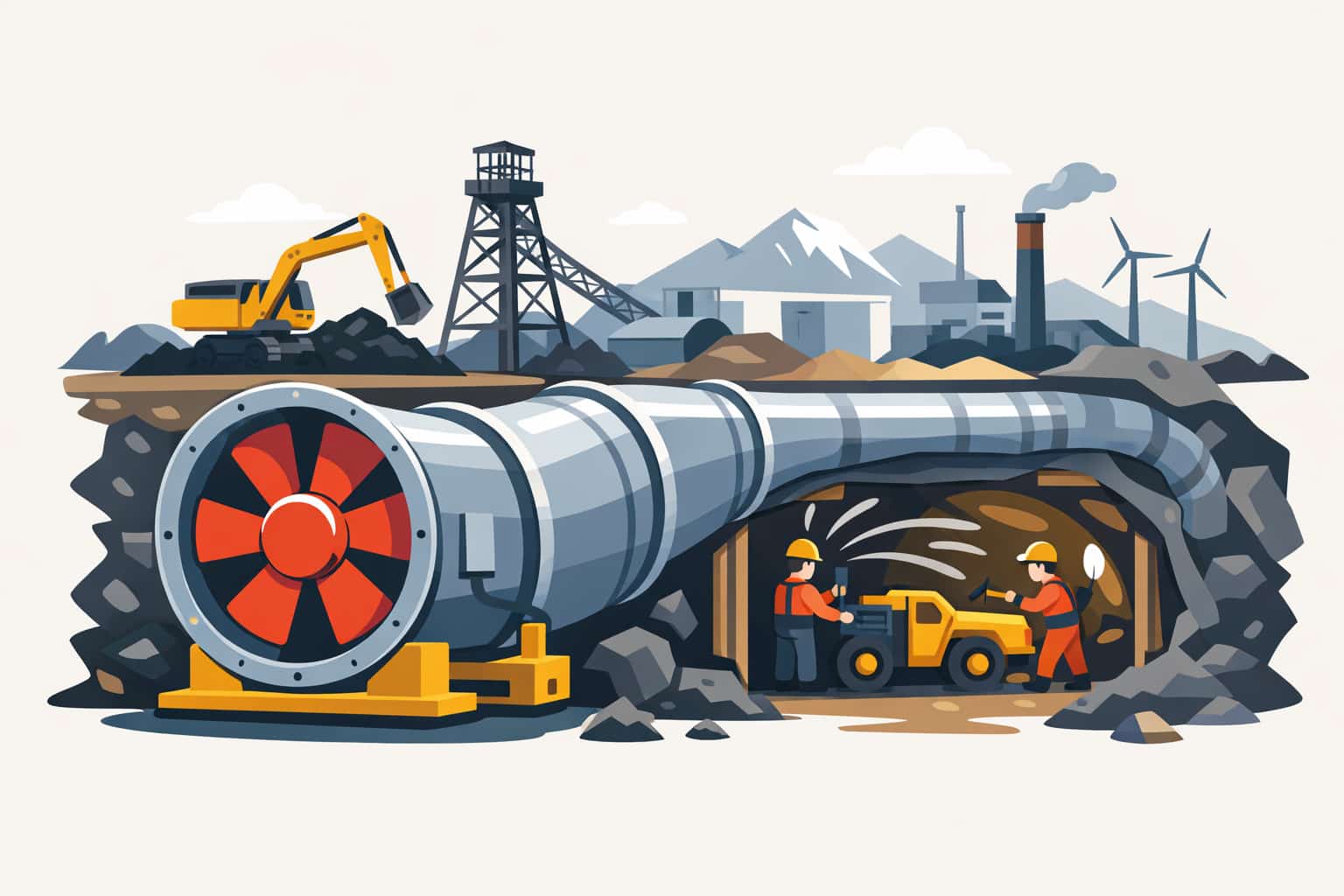
In mining ventilation, the “mining fan vs mining blower” question comes up often because the terms “fan” and “blower” are used interchangeably—especially underground, where crews may call a ducted auxiliary unit a “blower.” But names don’t deliver air to the face. What matters is the real operating point: airflow (Q) at the required static pressure (Ps) under real system losses, leakage, and changing resistance.
Quick definition: Q is airflow (m³/s or m³/min). Ps is static pressure (Pa or in.w.g.). Your equipment must meet Q @ Ps at the target location (often the end of duct)—not in a low-resistance, near-free-air condition.
Decision rule (mining-first): If air is delivered through ducting, select by end-of-duct Q @ Ps. If it’s mine-wide ventilation, select by network duty point (main/booster) and confirm stable operation across expected resistance changes.
This guide explains the difference in a mining-first way: terminology vs performance, where each term is commonly used (main/booster/auxiliary), and how to select equipment that actually delivers air where you need it.
Looking for Mining Blower Products?
Explore our high-pressure auxiliary fans & blowers for underground ventilation.
Key Takeaways (Fast Answer)
In mining, “blower” often refers to a ducted auxiliary unit (often called an auxiliary ventilation fan), not a guaranteed “higher-pressure machine.”
Select using the duty point: Q @ Ps at the real target point (often the end of duct), not a free-air rating.
Duct length, bends, reducers, and leakage can sharply reduce delivered airflow even when the nameplate looks strong.
Use VFD and practical margin to stay in a stable, efficient operating zone as resistance changes.
Two Meanings You'll Hear: Engineering Definition vs Mining Usage
1) Engineering view (pressure capability)
In engineering language, “fan” and “blower” are sometimes separated by static pressure rise / pressure ratio. This can be a useful guideline, but it is not universal. Market naming is often mixed, and different industries draw boundaries differently. Treat terminology as a hint—not a specification.
Fan: often associated with lower to moderate static pressure for moving larger volumes of air.
Blower: often associated with higher static pressure capability for more resistant systems (long ducts, restrictions, filtration, etc.).
Bottom line: ignore the label and verify the curve at your duty point (Q @ Ps).
Tip: the operating point is where the fan curve intersects the system resistance curve. As duct length, leakage, regulators, and headings change, the system curve shifts—and delivered airflow shifts with it.
2) Mining usage (what people mean on site)
On site, “blower” often means a portable ducted auxiliary ventilation unit, while “fan” is more commonly used for main fans and booster fans. This is a naming habit tied to application—not a guaranteed performance class.
Is a “Mining Blower” Just an Auxiliary (Duct) Fan?
In many underground mines, yes—“blower” is a common name for a ducted auxiliary ventilation unit used to deliver air to headings. But the label alone does not confirm pressure capability. Always verify the duty point on the performance curve: required Q @ Ps at the duct end.
Rating Trap: Why “Free-Air” Numbers Fail Underground
A common pitfall is choosing by a “high airflow” figure measured at very low resistance (near 0 Pa). Underground headings rarely behave like that. Add long duct runs, bends, reducers, and leakage, and required static pressure rises. The operating point moves—and face airflow can drop sharply.
Remember: Free-air Q ≠ Face Q. For duct ventilation, design for the end-of-duct duty point and confirm usable margin for planned duct extension and leakage.

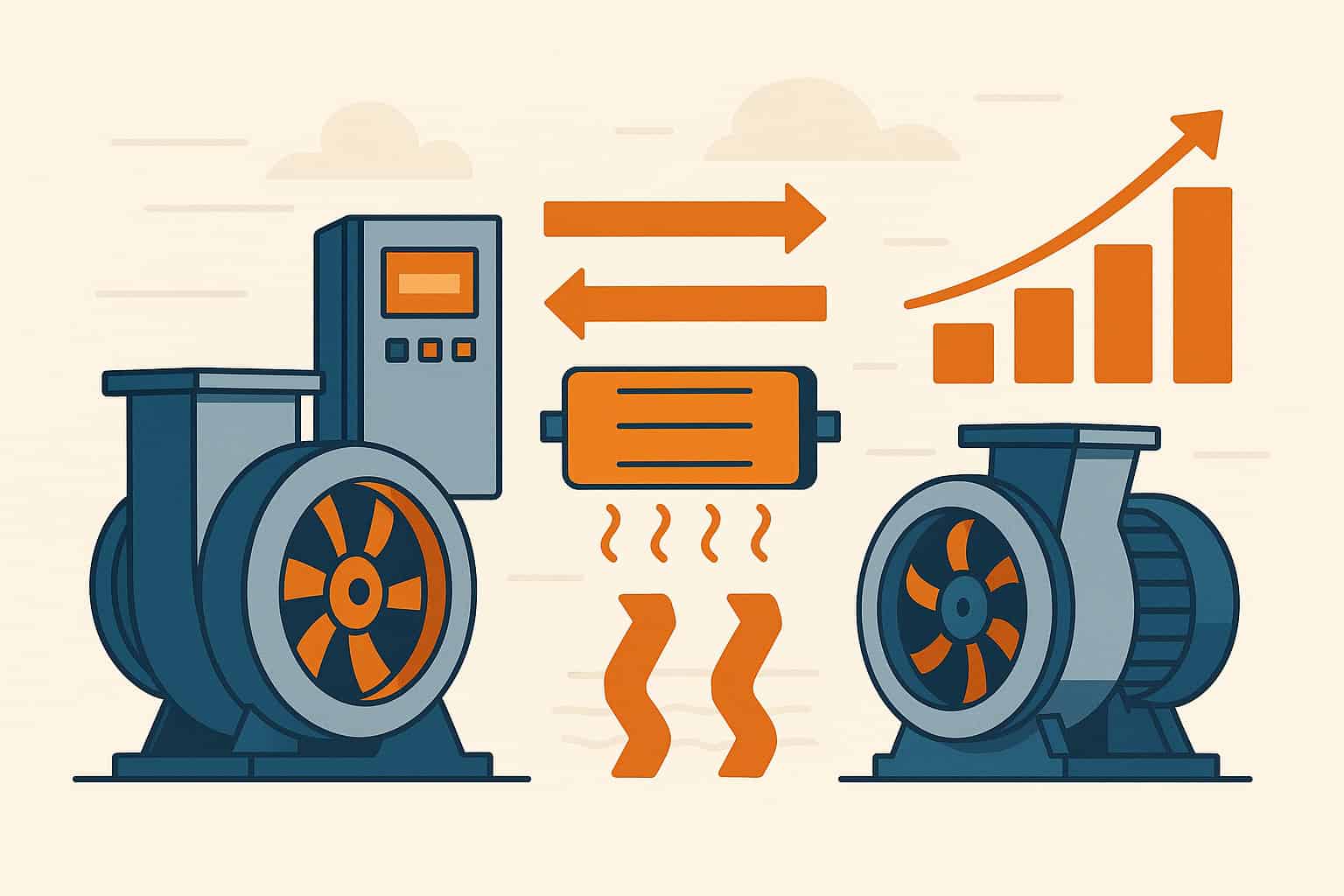
Figure: Longer ducts, bends, and leakage raise system resistance, shifting the operating point to lower airflow and higher static pressure—so select by end-of-duct Q@Ps, not free-air rating.
Why the Difference Matters Underground
Underground ventilation systems are not static. Resistance changes as headings advance, ducts extend, and controls are adjusted. A unit that looks fine on paper may fail in practice because:
Duct losses grow quickly with length, bends, and fittings.
Leakage steals airflow before it reaches the face.
Operating points shift as the mine expands and resistance increases.
This is why “fan vs blower” should be treated as a system matching problem, not a naming problem.
Don’t forget air density (altitude & temperature)
Air density affects fan behavior—especially static pressure and required motor power. At high altitude or high temperature, you may need density correction and extra motor kW margin. (Rule direction: lower density generally reduces achievable pressure at the same speed, and changes kW requirements.) Confirm correction before final selection.
Mining-First Comparison: Main vs Booster vs Auxiliary (Duct)
Tip: On mobile, swipe the table left/right to view all columns.
| Category | Main Mine Fan (Primary) | Booster Fan (District Support) | Auxiliary Fan / “Blower” (Duct Ventilation) |
|---|---|---|---|
| What it does | Drives airflow through the entire mine network | Supports airflow in a specific district / circuit | Delivers fresh air to headings via ducts |
| Typical requirement | Very high airflow, stable long-term operation | Airflow + pressure support as resistance increases | Airflow at the face under duct losses & leakage |
| Pressure profile | System-level pressure difference; varies by network | Moderate; must integrate safely with the network | Often higher local Ps demand due to long duct runs |
| Key risks | Reliability, efficiency, noise, monitoring | Recirculation, unstable flow, poor integration | End-of-duct airflow collapse, leakage, relocation losses |
| What to optimize | Efficiency at duty point, redundancy strategy | Stable operating zone + control strategy (VFD) | Duct integrity, pressure reserve, easy control/relocation |
Typical Equipment Choices (Axial vs Centrifugal) by Duty
Main mine ventilation fans: commonly use larger axial or centrifugal designs depending on network resistance, efficiency targets, noise limits, and installation layout (surface or underground station).
Booster fans: often require careful control (commonly VFD) to avoid recirculation and unstable flow, and must integrate safely with the network operating points.
Auxiliary (duct) ventilation fans / “blowers”: often prioritize practical static pressure capability and portability for long duct runs; selection should be based on end-of-duct Q@Ps with margin for duct extension and leakage.
3 Real Mining Scenarios (Where “Fan vs Blower” Goes Wrong)
Scenario A: “The unit is rated high, but the face feels starved.”
What’s happening: duct length increased, bends added losses, and leakage worsened. Required static pressure rose, so the operating point shifted away from where the unit performs well.
Reminder: what you need is end-of-duct airflow at the face—not a free-air number or fan outlet airflow.
Fix the system first: seal joints, reduce sharp bends, improve duct quality, and re-check losses.
Then select equipment: choose a unit that can deliver the required Q @ Ps at the duct end with usable margin.
Scenario B: “We oversized for margin and now it’s noisy and unstable.”
What’s happening: oversizing can push operation into inefficient or unstable zones (noise/vibration), especially as resistance changes.
Better approach: size for your expected duty range and use VFD control to stay within stable, efficient operating zones.
Scenario C: “The mine expanded; airflow distribution got worse with the same main fan.”
What’s happening: network resistance increased and distribution changed. The operating point shifted.
Selection mindset: update resistance assumptions and confirm main/booster fans meet new duty points without creating recirculation or dead zones.
Forcing vs Exhausting Duct Ventilation (Which Works Better for Headings?)
In development headings, duct ventilation is commonly configured as forcing (blowing fresh air to the face) or exhausting (extracting contaminated air from the face). The better option depends on dust/gas sources, duct layout, and how well leakage and recirculation are controlled.
Forcing ventilation: often preferred for direct fresh-air delivery and stable duct delivery to the face.
Exhausting ventilation: can help control contaminants if duct routing and leakage control are strong.
Either way: size for end-of-duct airflow, expect resistance growth, and use control (often VFD) to stay stable.
Safety note: always follow your mine ventilation plan and site procedures when changing ducting arrangements or control settings.
Common Selection Mistakes (That Cause Airflow Failures)
Choosing by the word “fan” or “blower” instead of Q @ Ps at the real target point.
Using free-air numbers instead of duty-point performance.
Ignoring duct leakage (poor joints can steal a large part of airflow before the face).
Using only kW/rpm/diameter to decide (these do not guarantee the right duty point).
Not allowing margin for duct extension or future resistance growth.
Skipping density correction when sizing motor kW and pressure margin.
FAQ: Mining Fan vs Mining Blower (Quick Answers)
Is a blower always higher pressure than a fan?
Not always. Naming varies by market and application. Always confirm performance at the required duty point (Q @ Ps) on the curve.
Why does end-of-duct airflow drop so much underground?
As headings advance, duct length increases, bends add losses, and leakage grows. All of these raise required static pressure and shift the operating point.
What should I use: free-air rating or duty point?
Use the duty point. Free-air rating is not what you get at the face. Selection should target required end-of-duct airflow at the needed static pressure.
How much pressure margin should I allow?
Enough to handle planned duct extension and expected leakage deterioration without pushing the fan into an unstable or inefficient zone. VFD control often helps across a duty range.
How to Choose: The Only Question That Matters (Q @ Ps)
How much airflow do you need, at what static pressure, in your real system (including duct losses and leakage)?
Step 1: Define required airflow (Q)
Base this on your ventilation plan and site requirements (gas dilution, dust control, heat/humidity control, and working face needs).
Step 2: Estimate total resistance / static pressure (Ps)
For duct ventilation, include duct length, diameter, bends, reducers, leakage expectations, and fittings. For mine networks, include projected development and resistance growth.
Step 3: Match the performance curve (not the nameplate)
Choose equipment whose curve meets your duty point with usable margin and reasonable efficiency. Avoid running far from the efficient region for continuous operation.
Step 4: Plan for variability
Mines change. If headings will advance or ducts will extend, plan for the duty point to shift. Use VFD when appropriate to maintain stable performance.
Inquiry-Ready: What to Send for Fast Selection (Copy/Paste Checklist)
If you want a quick, accurate recommendation (and not a guess), send the data below. This is also suitable as a website inquiry form.
| Item | Example / Notes |
|---|---|
| Application | Main / Booster / Auxiliary (duct) / Tunnel / Raise / Stope |
| Required airflow at target point | m³/s or m³/min (state where measured: shaft, district, face, duct end) |
| Estimated static pressure | Pa (or provide duct/network details for calculation support) |
| Duct details (if ducted) | Diameter, total length, number of bends, reducers, duct material/type, typical leakage condition |
| Installation constraints | Available space, inlet/outlet direction, mounting type (fixed/portable), silencer/duct connection limits |
| Power & control | Voltage/frequency, VFD required (Y/N), preferred control method |
| Site conditions | Altitude, ambient temperature, dust level, corrosion concerns |
| Compliance / certification | Mine safety requirements (e.g., explosion-proof / hazardous area compliance if applicable) |
| Noise limit (if any) | dB(A) target or “no specific limit” |
| Duty cycle | 24/7 continuous or intermittent; expected operating hours per day |
What you’ll receive: a recommended fan/blower type and size range, duty point (Q@Ps), curve margin suggestions, motor/power options, and practical notes on duct losses/leakage for your case.
Optional deliverables: preliminary layout suggestion, silencer/noise-control notes, and a short duct-loss/leakage checklist to improve end-of-duct airflow.
Typical response: once key inputs are provided, we can often reply with duty-point recommendations and selection notes within 1 business day.
Ready to size your ventilation fan? Send the checklist above via our inquiry form and we’ll reply with a recommended range and duty-point notes.
Bottom Line
In mining, “blower” often describes a ducted auxiliary ventilation unit, while “fan” is often used for main and booster duties. But the correct selection is always based on Q @ Ps in your real system—plus stability, efficiency, reliability, and safety. Share your duty point and duct/network details, and we can recommend a suitable range and operating margin instead of guessing.
References / Further Reading (Authoritative)
The references below are selected for authority and traceability. They come from U.S. government mining-safety bodies (CDC/NIOSH, DOE, CFR via govinfo) and ISO. They are useful for verifying ventilation fundamentals, dust/methane control context, and standardized fan performance testing terminology.
NIOSH: Handbook for Dust Control in Mining (PDF)— Practical dust-control guidance tied to ventilation and airflow management in mines.
Handbook for Methane Control in Mining (PDF)— Methane-control background and ventilation-related safety context (public archival copy).
30 CFR § 75.370 — Mine Ventilation Plan; Submission and Approval (PDF)— Direct regulatory language on ventilation plans (useful when discussing “plan-driven” ventilation changes).
U.S. DOE: Commercial & Industrial Fans RFI (definitions & terminology) (PDF)— Government terminology context around “fans” and “blowers” (helpful when explaining naming vs performance).
ISO 5801 — Fans: Performance testing using standardized airways— The core international reference for standardized fan performance testing conditions and methods.
Internal Links
Axial vs Centrifugal Fans: Complete Guide (Mining Ventilation Focus)— Selection mindset, duty-point thinking, and where each type fits in mining ventilation.
What Is an Axial Flow Fan?— How axial fans work, typical mining use cases, and practical selection considerations.
What Is a Centrifugal Fan?— Centrifugal fan basics, pressure/flow characteristics, and where they are commonly used in mines.